

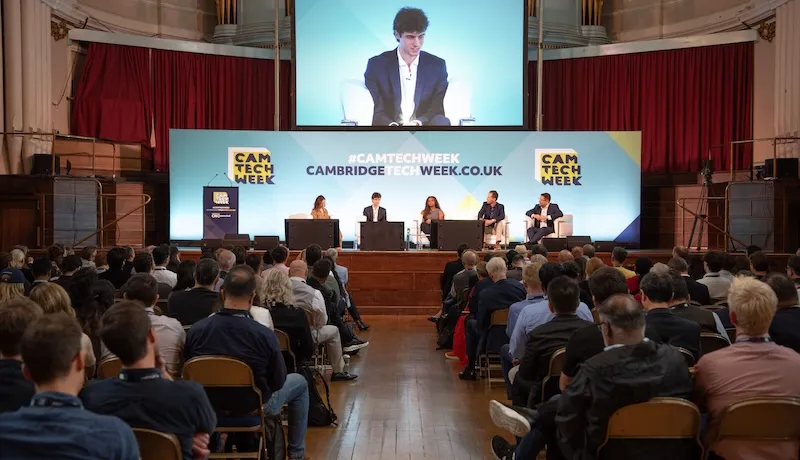
More than 1,700 delegates from 52 countries attended Cambridge Tech Week this year, a 15% increase on the previous edition, as the five-day gathering placed a growing emphasis on turning deep-tech research into commercial businesses.
The event, held from 14 to 18 September, brought together founders, investors, researchers, policymakers and technology companies for discussions spanning artificial intelligence, quantum computing, healthtech, energy, infrastructure and security. Held under the theme How Deep Tech Changes the World, much of the programme focused on the challenges involved in moving emerging technologies beyond the laboratory and into commercial applications.
Deep tech moves from research to commercial reality
Commercialisation, access to investment and collaboration between researchers and industry featured prominently across the week, alongside discussions about the infrastructure needed to support technologies including AI and quantum computing. The event reflected a broader shift in the innovation economy: deep-tech ventures are no longer judged solely by scientific novelty, but by their ability to build viable products, attract capital, navigate regulation and scale manufacturing and deployment.
Cambridge has long been associated with breakthrough science, from the discovery of the structure of DNA to advances in computing, engineering and biomedicine. That heritage gives the city a dense network of university laboratories, spinouts, angel investors, specialist funds and corporate research teams. Converting that density into commercial outcomes, however, remains difficult. Deep-tech companies often face longer development timelines than digital startups, require expensive equipment and highly specialised talent, and must prove their technologies in regulated environments such as healthcare, energy and defence.
The week's programme examined those bottlenecks directly. Sessions looked at how researchers can work more closely with industry, how founders can access patient capital, and how infrastructure such as advanced computing, clean energy and secure data systems can support the next generation of technology companies. The presence of investors, policymakers and corporate executives alongside founders signalled that deep-tech commercialisation is increasingly a collective challenge rather than a purely academic or entrepreneurial one.
For early-stage companies, the pitch competition and exhibition were not merely showcases. They were opportunities to test commercial narratives, meet potential customers and connect with investors who understand the long timelines of hardware, biotech and advanced materials. The week also provided a reminder that deep tech requires ecosystems, not isolated inventions: universities, incubators, specialist service providers, regulators and large corporates all have roles to play in helping a laboratory breakthrough become a product that can be manufactured, regulated and sold at scale.
Innovation Alley and the pitch competition
More than 80 emerging companies and scaleups exhibited at Innovation Alley at Cambridge Guildhall, while the event's pitch competition showcased a group of early-stage technology companies. The exhibition format gave younger ventures a chance to demonstrate hardware, software and platform technologies to potential customers, partners and backers.
Myonerv won the 2026 Cambridge Tech Week Pitch Competition for its wearable neurostimulation technology, which is being developed to help stroke patients regain movement. The startup was founded by chief executive Sam Kamali, whose motivation for developing the technology followed his cousin suffering a stroke aged 11 after a bleeding brain tumour caused by previously undiagnosed leukaemia.
Neurostimulation is an area of growing interest in rehabilitation medicine. By delivering targeted electrical or magnetic stimulation to nerves or muscles, such devices aim to retrain neural pathways and support recovery after neurological injury. A wearable approach could allow patients to receive therapy outside hospital settings, potentially increasing the intensity and consistency of rehabilitation while reducing the burden on clinical facilities. For stroke survivors, regaining motor function can be transformative, affecting independence, employment and quality of life.
Agritech startup LAMBDA was named the People's Choice winner. The company is developing advanced photonic materials designed for use in greenhouse agriculture. Photonics involves the control and manipulation of light, and in controlled-environment agriculture it can be used to optimise the spectrum and intensity of light that plants receive. Better light management can influence growth rates, crop quality, energy use and resilience, making it relevant to food security and sustainable farming. The two companies shared a £7,500 prize.
International delegations and cross-border collaboration
The event also attracted a significant international presence, with delegations attending from countries including Finland, Romania, Estonia and Serbia. The British-Serbian Chamber of Commerce brought more than 20 companies to Cambridge, with eight Serbian businesses exhibiting across areas including AI, telecommunications, cybersecurity, agritech, healthtech and biotechnology.
International participation highlights how deep tech is becoming a matter of cross-border competition and cooperation. Countries are seeking to build sovereign capabilities in AI, quantum, semiconductors, cybersecurity and biotechnology, while also trying to attract investment, talent and market access. For smaller economies, events such as this can provide a bridge to research clusters, venture capital and corporate partners that would otherwise be difficult to reach.
The mix of delegations also underlined the geopolitical dimensions of technology. AI, quantum computing and advanced materials are increasingly viewed through the lens of economic security, export controls and strategic autonomy. At the same time, global challenges such as healthcare, energy transition and food production require collaboration across borders. The week's sessions attempted to balance those tensions by examining both the opportunities and the policy constraints facing innovators.
Infrastructure, energy and the civilian-defence boundary
Other parts of the programme focused on some of the infrastructure and policy challenges associated with the next generation of technology. Sessions examined the growing energy demands associated with AI, sovereign computing capabilities and the increasing crossover between civilian and defence technologies.
The energy intensity of AI has become a central concern as models grow larger and data centres consume more power. Discussions around AI infrastructure now involve not only chip supply and data availability but also electricity generation, grid capacity, cooling and sustainability. Quantum computing presents different infrastructure challenges, including ultra-cold operating environments, specialised fabrication and a scarce talent pool. Sovereign computing capabilities, meanwhile, raise questions about where data is stored, who controls critical systems and how countries can reduce dependence on foreign providers.
The Big Tech Debate focused on dual-use technology and the changing boundary between civilian and defence innovation, while separate sessions examined the development and commercialisation of AI, quantum and health technologies. Dual-use technologies can serve both commercial and military purposes, from advanced sensors and robotics to AI-enabled analytics and secure communications. As those boundaries blur, founders and investors must consider export controls, procurement rules, ethical concerns and public scrutiny.
Voices shaping the deep-tech agenda
Speakers during the week included BenevolentAI founder Kenneth Mulvany, author Calum Chace, CMR Surgical co-founder Mark Slack, Balderton Capital general partner Suranga Chandratillake and LinkGevity founder Dr Carina Kern.
Their backgrounds reflect the breadth of the deep-tech ecosystem. AI-driven drug discovery, surgical robotics, venture capital, longevity research and writing on the future of artificial intelligence all intersect with the commercialisation challenge. Mulvany's experience building an AI drug discovery company illustrates the long timelines and high costs of biotech; Slack's work with surgical robotics shows how hardware, software and clinical validation must come together; Chandratillake's role as an investor highlights how capital allocation shapes which technologies reach the market; and Kern's focus on longevity research points to emerging areas that could redefine healthcare and ageing.
The week also highlighted the importance of talent and skills. Deep-tech companies need engineers, scientists, clinicians, regulatory specialists and operators who can translate research into products. Building teams that combine technical depth with commercial discipline is one of the most persistent challenges for scaleups, particularly when competition for AI, quantum and biotech talent is global. Universities and research institutes can supply pipelines of skilled graduates, but startups must also offer attractive career paths, equity and the chance to work on difficult, meaningful problems.
Investment remains another critical variable. Deep tech often requires larger upfront funding rounds than software startups, and the path to revenue can be longer and less predictable. Patient capital from specialist funds, corporate venture arms, government-backed programmes and philanthropic sources can help companies survive the so-called valley of death between research grants and commercial sales. The presence of investors at the event underscored that access to capital is not an abstract policy issue but a practical determinant of which technologies make it to market.
Michaela Eschbach, chief executive of the organisation that runs Cambridge Tech Week, said the event was a powerful demonstration of Cambridge's global leadership in deep tech. Across five extraordinary days, she said, it brought together the people, ideas and technologies with the potential to change the world, creating connections and conversations that would continue long beyond the event itself.
Source: UKTN News