

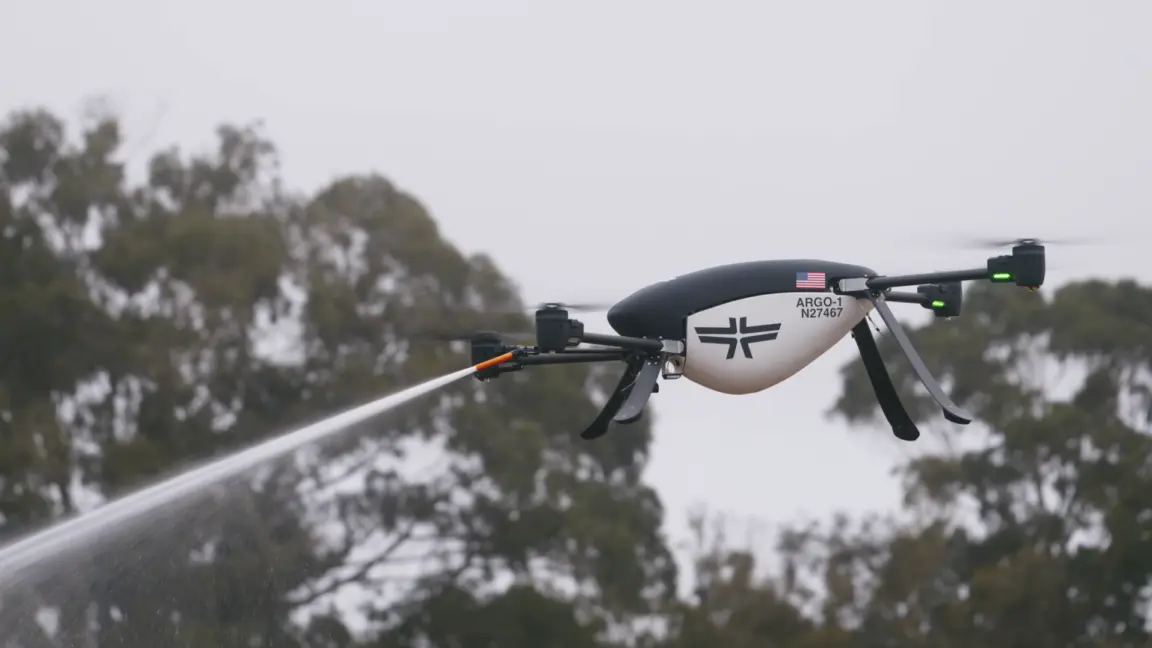
Drones capable of spraying water and fire retardants have been practicing how to snuff out wildfires early in California and Alaska this summer, demonstrating a possible rapid-response tool for firefighting as climate change transforms wildfire season into a nearly year-round risk for much of the United States.
Most drones are significantly smaller than crewed aircraft and have shorter flight ranges, meaning they cannot replace large airtankers delivering massive payloads to remote wildfires. But companies, fire agencies, and the organizers of the $11 million XPRIZE competition are testing whether drones can help crews respond more quickly to small fires and put them out before they become more destructive.
A small but nimble tool
The California Department of Forestry and Fire Protection, known as CAL FIRE, ran its own field test involving five autonomous drones that worked together to deploy between 500 and 1,000 gallons of foam for suppressing fires on July 15. The demonstration was organized with the help of the nonprofit FireWERX and the California-based company Seneca, which is making the drones commercially available starting in 2026.
Each of Seneca’s Argo-1 drones can carry about 100 pounds of water or fire retardant while working together in swarms of four to six drones. Once a human operator uploads a GPS waypoint, the autonomous drones fly toward their target and use onboard sensors to spot the heat signature of a fire. The drones then find the best hovering altitude before each lines up to spray the fire, one after the other.
The fully loaded drones are limited to a round trip of 10 miles while flying at about 30 miles per hour on average, which means they would ideally need to be prepositioned in fire-prone areas or first transported by ground vehicle. But each drone can fit in the back of a pickup truck with the tailgate down, and two people can even manually carry the empty drones.
The company says the goal is to enable firefighters to refill a returning drone’s payload and swap in a fresh battery so that it is ready to fly again in two minutes. Seneca previously demonstrated its drone technology for San Bernardino County Fire in December 2025.
Advocates of drone-based suppression argue that even modest payloads can make a difference in the first few minutes of a fire, when a small flame can still be stopped with a direct hit of water, foam, or retardant. Traditional airtankers and helicopters often take longer to arrive, especially in rugged terrain or during periods when high winds ground manned aircraft. Drones can be stationed in vulnerable areas and launched quickly from portable platforms, potentially giving fire crews a critical head start.
That kind of early intervention is becoming more important as climate change lengthens fire seasons and intensifies drought conditions across the West and beyond. Wildfires that once appeared mainly in summer months now ignite in winter and spring, spreading through dry grass, brush, and forests. The National Interagency Fire Center has recorded more large fires in recent decades, and the cost of suppressing those fires has grown into the billions of dollars annually. Fire managers are increasingly looking for any tool that can slow the spread of a blaze before it becomes an emergency.
Testing in the Alaskan wilderness
Separately, the XPRIZE Wildfire competition gave another firefighting drone system its own trial by fire in finals testing just outside of Fairbanks, Alaska, in June 2026. The Silvaguard autonomous firefighting drone system, developed by the German company Dryad Networks, worked with Dryad’s Silvanet wildfire detection network to autonomously detect and suppress a wildfire within the competition’s 1,000 square kilometer test area.
Dryad’s detection system consists of solar-powered sensors attached to trees that are designed to detect the smoke from a smoldering fire. When a sensor triggers an alarm via a wireless mesh network to an Internet-connected border gateway device, a prepositioned Silvaguard observation drone launches to confirm and geolocate the fire using infrared and optical imaging sensors, while also ensuring that it is not a false alarm.
That sets the stage for a Silvaguard suppression drone to take off and deploy up to 26 gallons of fire suppressant onto the fire. The drones can be prepositioned inside solar-powered, spherical hangar pods, allowing them to remain in remote areas for extended periods without needing crewed infrastructure. The design reflects a broader push in wildfire technology toward fully autonomous networks that can detect, confirm, and attack a fire without waiting for human dispatch.
The XPRIZE Wildfire competition was launched to accelerate innovation in firefighting technology, offering a $11 million prize purse to teams that could demonstrate autonomous detection and suppression in realistic conditions. Finalists from around the world brought different approaches, from ground robots to aerial swarms. The Alaska testing environment was chosen because of its large, remote landscapes and the presence of fire-prone boreal forests, which are increasingly vulnerable to severe burning as the Arctic warms faster than the global average.
Dryad Networks has positioned its system as a complement to, rather than a replacement for, traditional firefighting resources. While 26 gallons is a modest amount compared to a single helicopter drop, the company emphasizes that the system is meant to catch fires during their earliest moments, often before they are visible from roads or lookout towers. A fire that can be suppressed in the smoldering stage may require little more than a few gallons of water mixed with a suppressant gel or foam.
Early adopters and big potential
The ultimate test for whether Dryad’s system or Seneca’s drones can nip fires in the bud will come if fire agencies deploy them during the lengthening wildfire season. The Aspen Fire Protection District in Colorado has become an early customer by already committing to a $5 million contract for deploying five of Seneca’s drones over five years. The district oversees a mountainous area with a mix of forest, grassland, and residential communities, making it a prime candidate for quick-response drone technology.
CAL FIRE has not signed up any firefighting drones just yet, but it represents another large potential customer. The California fire agency already operates the world’s largest aerial firefighting fleet with more than 70 crewed fixed-wing aircraft and helicopters, along with using AI-powered camera networks and supporting development of the FireSat constellation designed to spot wildfires from space even faster.
The involvement of such major players signals growing confidence in drone technology, even as limitations remain. A single Argo-1 drone cannot carry nearly as much water as an airtanker, and its range is limited by battery life and payload weight. But by deploying several drones in a coordinated swarm, companies hope to create a scalable system that can be moved quickly to high-risk areas, repositioned as conditions change, and operated with fewer personnel than a crewed aircraft requires.
Cost is another factor driving interest. Large airtankers are expensive to maintain, require pilots and trained crews, and can be grounded by poor visibility or high winds. Drones offer the possibility of lower operating costs, faster launch times, and the ability to operate in environments that would be dangerous for human pilots. They also can be used for surveillance and situational awareness, giving incident commanders real-time video and thermal imaging without putting another crew in the air.
Some researchers caution that drone-based suppression is still in its infancy and should not be oversold. Regulatory hurdles remain, especially for flying beyond the pilot’s line of sight. Airspace conflicts with crewed firefighting aircraft must be carefully managed, and equipment durability in smoky, unpredictable conditions has not yet been proven over many seasons. Still, the recent demonstrations in California and Alaska suggest that the technology has moved beyond concept stage and into operational testing.
As wildfire seasons become longer and more destructive, the pressure to innovate will only increase. Communities in fire-prone regions are seeking every advantage they can get, from better building codes and vegetation management to early-warning sensors and automated drones. Whether the current crop of firefighting drones becomes a standard tool will depend on real-world performance, regulatory approval, and the willingness of fire agencies to invest in a new generation of equipment.
For now, the recent field trials show that autonomous drones can already detect heat signatures, fly to precise locations, and release fire suppressant in coordinated attacks. The next step is integrating these systems into the broader emergency response network so that drones, ground crews, airtankers, and cameras all share information and act seamlessly. Firefighters may always need large aircraft and bulldozers for big blazes, but the drones being tested today could become the first line of defense, catching fires small and cheap while they are still manageable.
Source: Ars Technica News