

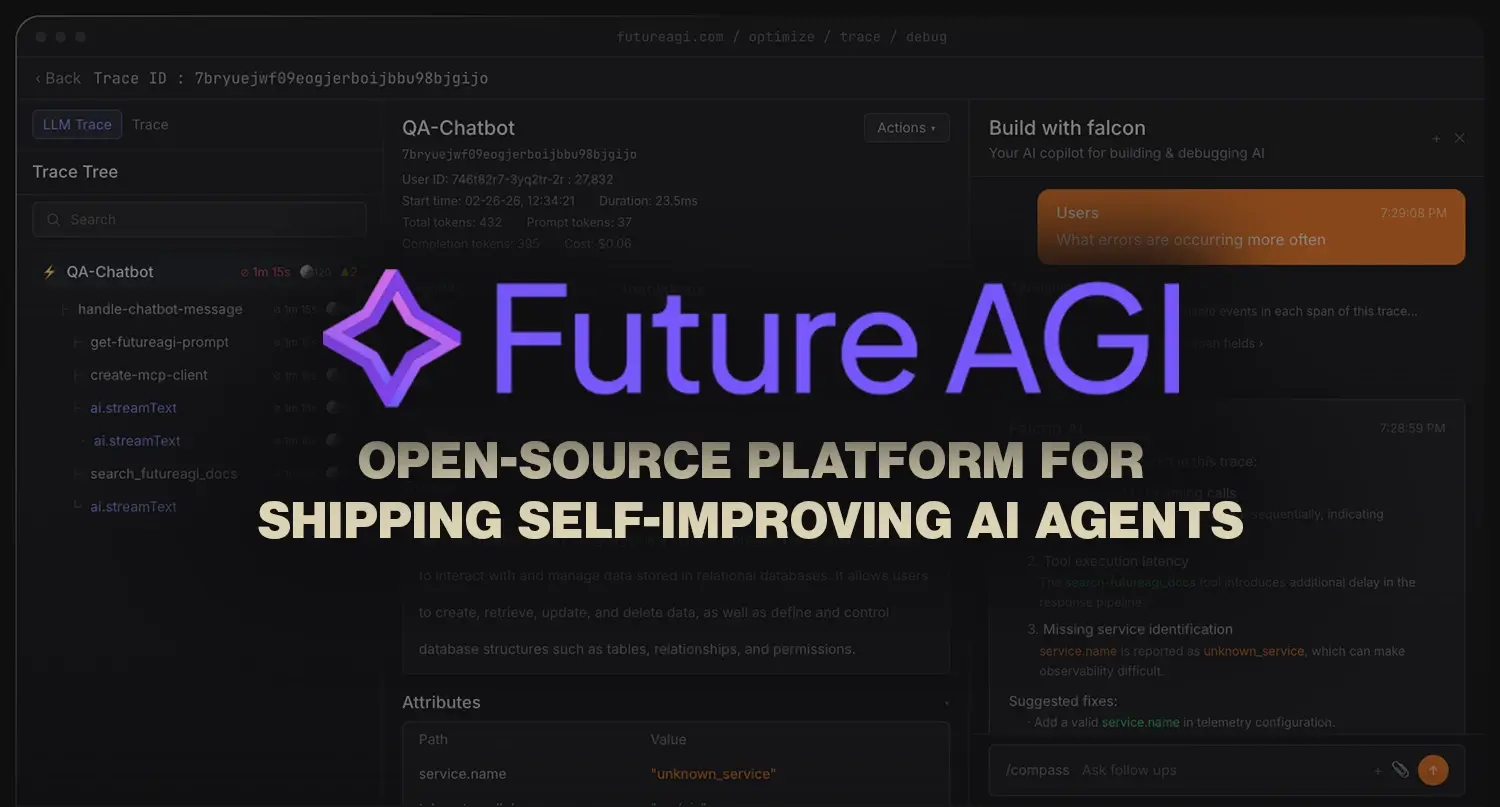
Future AGI is an open-source platform designed to help developers ship self-improving AI agents with confidence. It provides a comprehensive suite of tools for tracing, evaluating, simulating, and guardrailing LLM agents. The platform is licensed under Apache 2.0 and is self-hostable, giving organizations full control over their data and infrastructure.
One of the key aspects of Future AGI is its focus on observability. The platform automatically traces every step an AI agent takes, from the initial prompt to the final output, including all tool calls in between. This level of transparency is crucial for debugging complex agent workflows and ensuring that models behave as expected. By integrating with OpenTelemetry, Future AGI supports more than 50 agent frameworks, including popular ones such as LangChain, LlamaIndex, CrewAI, and DSPy.
Telemetry and Privacy
Future AGI is designed with privacy in mind, but it does include a telemetry mechanism that activates on first boot. When a self-hosted instance is started for the first time, it registers with Future AGI's servers. This registration sends an instance ID, a version string, a deployment type, and the email addresses and domains of active admin users. This communication happens once, before anyone signs in to the dashboard.
Operators who prefer to disable telemetry can do so by setting the environment variable FUTURE_AGI_TELEMETRY_DISABLED=1 in the .env file before the first startup. If this variable is set after the first boot, the admin list has already been transmitted. The platform also supports air-gapped and on-prem deployments, which are described as phone-home free. When telemetry is disabled, only one census ping is sent, containing the instance ID, version, and deployment type, while email addresses are withheld. Periodic heartbeats cease as well.
The Future AGI documentation includes a note for operators who require absolute silence: “turn networking off at the edge if you need full silence.” This suggests that the platform can operate entirely without external communication, making it suitable for highly secure environments.
Architecture and Components
The installer for Future AGI brings up a stack of backend services, including ClickHouse, PostgreSQL, Redis, RabbitMQ, and Temporal. These services work together behind a dashboard that is available on localhost:3000. Spans, which represent individual units of work in a trace, are stored in ClickHouse, a column-oriented database designed for analytics. Prompt text, model output, and tool calls pass through the tracer on their way into this store, ensuring that all relevant data is captured for later analysis.
This architecture is built for scalability. ClickHouse handles high-volume trace data efficiently, while PostgreSQL serves as the relational database for metadata and configuration. Redis provides caching and pub/sub capabilities, RabbitMQ manages message queues, and Temporal orchestrates durable workflows. This combination allows Future AGI to handle complex agent interactions that involve multiple steps and long-running processes.
Security is a core component of the platform. A defender module inherits the access controls on the underlying database, meaning that only authorized users can view or modify traces. This tight integration between tracing and security ensures that sensitive data is protected throughout the agent lifecycle.
The Gateway: Agent Command Center
At the heart of Future AGI is the Agent Command Center, an OpenAI-compatible proxy that fronts more than 100 providers. This gateway acts as a unified entry point for all AI agent traffic, offering routing strategies, semantic caching, virtual keys, and support for MCP (Model Context Protocol) and A2A (Agent-to-Agent) communication. Every provider credential in a deployment terminates at this gateway, centralizing security and access management.
The routing strategies allow developers to direct requests to different models based on cost, latency, or specific task requirements. Semantic caching improves performance by reusing responses to similar queries, reducing the load on underlying models and cutting operational costs. Virtual keys enable granular control over API access, allowing administrators to issue temporary or scoped credentials without exposing the master keys.
MCP and A2A support are particularly relevant for the emerging ecosystem of interoperable AI agents. MCP provides a standardized way for agents to access external tools and data sources, while A2A enables agents to communicate and coordinate with each other. These protocols are still evolving, but Future AGI's early adoption positions it as a forward-looking platform for agent-based AI development.
Security and Guardrails
Future AGI includes a module called Protect, which ships with 18 built-in scanners for detecting personally identifiable information (PII), jailbreak attempts, and prompt injection attacks. These scanners are designed to catch common threats before they reach the underlying model or after the model generates a response. In addition to the built-in scanners, vendor adapters cover external security tools such as Lakera, Presidio, and Llama Guard, allowing organizations to integrate their preferred security solutions.
The scanners can run inline in the gateway or standalone through the SDK, giving developers flexibility in how they deploy security controls. Inline scanning is optimized for low latency; the project's benchmark harness shows that inline scanning holds P99 latency at or under 21 milliseconds. This level of performance is critical for interactive applications where users expect near-instant responses.
Prompt injection is one of the most significant security challenges in the AI agent space. Attackers can craft inputs that trick a model into executing unintended actions or revealing sensitive information. By scanning both incoming prompts and outgoing outputs, Future AGI helps mitigate these risks. PII detection is equally important, especially for organizations that handle personal data and must comply with regulations like GDPR or HIPAA.
Simulation and Evaluation
Beyond tracing and security, Future AGI provides tools for simulating and evaluating agent behavior. Simulation allows developers to create synthetic environments where agents can be tested against a wide range of scenarios without deploying them to production. This is particularly useful for self-improving agents, which may need to learn from experience or adapt to changing conditions. Evaluation tools measure the quality of agent outputs, using metrics such as accuracy, relevance, and safety.
The combination of simulation and evaluation enables a continuous improvement loop. Developers can run agents in a sandbox, identify failure modes, refine prompts or model parameters, and then re-test. Once agents perform well in simulation, they can be promoted to production with confidence. The tracing and guardrailing features then monitor their behavior in real-world conditions, feeding data back into the development cycle.
Self-Improving AI Agents
The concept of self-improving AI agents has gained traction as language models become more capable. In practice, self-improvement often involves agents that can call external tools, learn from feedback, or refine their own prompts based on outcomes. Future AGI's infrastructure supports this by providing a robust framework for observability and iterative development.
Without proper guardrails, self-improving agents can drift from their intended behavior or produce harmful outputs. The tracing and evaluation capabilities in Future AGI allow developers to catch these issues early. The platform also supports human oversight, enabling operators to review agent decisions and intervene when necessary.
Open-Source and Community
Future AGI is available for free on GitHub, making it accessible to individual developers, startups, and enterprises alike. Open-source licensing under Apache 2.0 grants broad rights to use, modify, and distribute the software, with the only requirement being that modifications are documented when redistributed. This encourages community contributions and ensures that the platform evolves to meet the needs of its users.
The open-source model also provides transparency, which is essential for security-focused organizations. Operators can inspect the code to verify telemetry behaviors, audit the scanners, or customize the platform to fit their specific requirements. The self-hostable nature of Future AGI means that even the most sensitive deployments can keep all data within their own infrastructure.
As AI agents become more prevalent in enterprise applications, the need for robust development and security tooling will only grow. Future AGI addresses this need with a comprehensive, open-source platform that balances functionality with privacy and security. The project's focus on self-improving agents, combined with its extensive integrations and low-latency security scanning, makes it a noteworthy addition to the AI engineering toolkit.
Source: Help Net Security News