

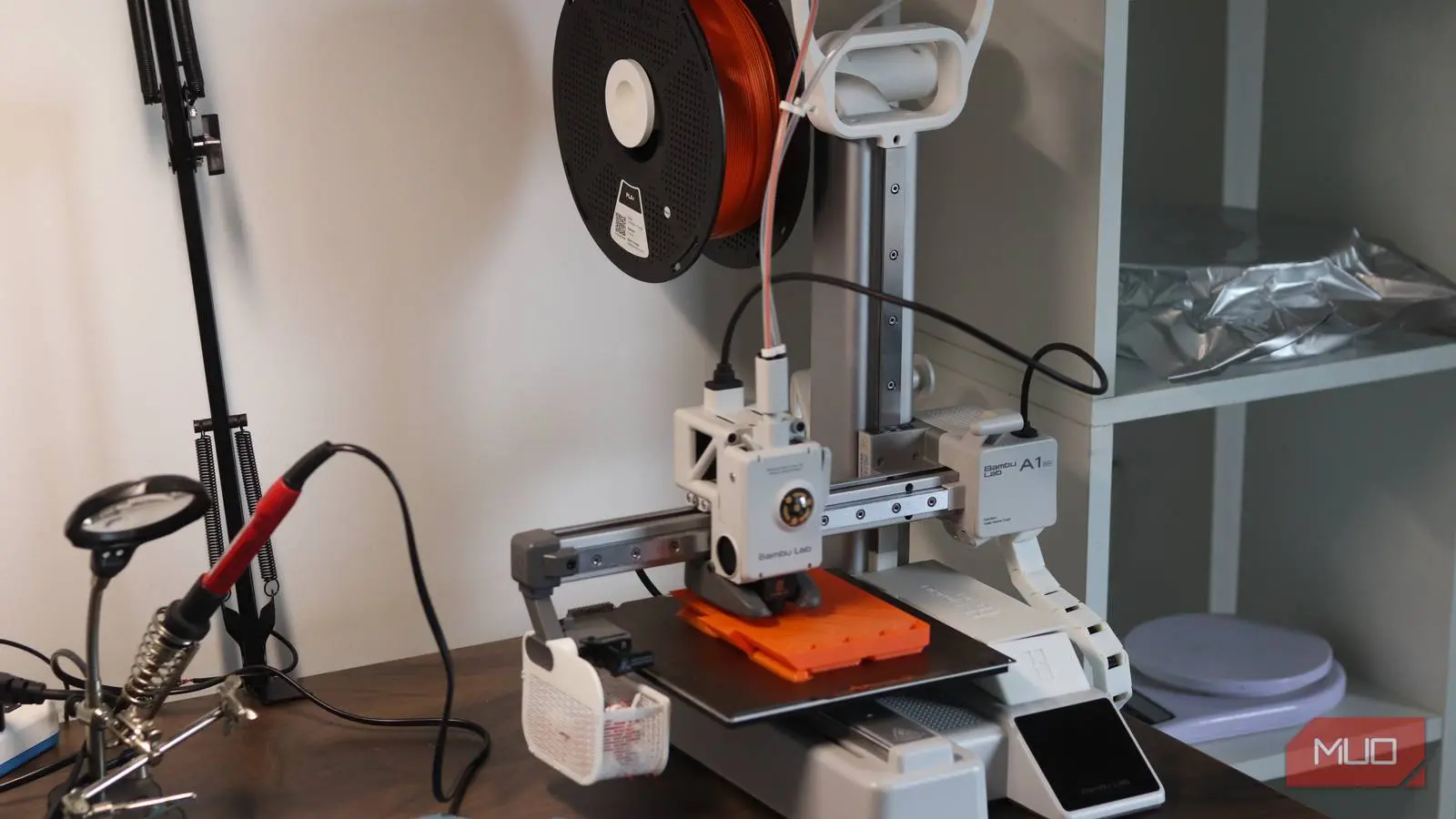
I had prior experience with 3D printing before I first bought one. My first job, straight out of high school, involved repairing and maintaining two 3D printers all the way back in 2017. I fixed those printers, and they ran just fine as long as I was tending to them. They got me hooked on the idea of 3D printing, but they were also the reason I put off buying one for myself for nearly a decade.
When I finally got one in 2026, it turned out I was worrying for nothing. Modern 3D printers have come a long way from their ancestors, and 3D printing is truly approachable for anyone now, not just limited to hobbyists and creators. This realization did not come easily; it required revisiting the mental models I had built during those early years of tinkering with finicky machines. The transition from the rugged, industrial-like devices of the past to today's sleek, user-friendly appliances is a testament to how rapidly consumer technology can evolve.
The printer was never the problem
I overestimated the noise, space, and disruption a 3D printer would bring
My early experience with 3D printing revolved primarily around the Wanhao Duplicator 3 — a massive, heavy, nearly industrial 3D printer with a relatively small bed but a massive enclosure. I'd slice files on my PC, move them to a microSD card, take it over to the printer, and print only to find that my eyeballed bed-levelling with a sheet of paper wasn't accurate enough. Not to mention the loud noises the printer produced. It sounded like a workshop machine, with constant whirring and vibration that made it impossible to work in the same room.
I wanted my 3D printer to sit on my electronics workbench, where I work on hardware projects, so size was a real constraint. And since it's right next to my actual work desk, I was worried that constant noise from the printer would be a massive distraction. I envisioned a device that would hum and clatter for hours, demanding my attention and disrupting my flow. In contrast, modern 3D printers like the Bambu Lab A1 Mini are designed with quiet operation in mind. The A1 Mini uses advanced silent stepper motor drivers and a well-damped frame to minimize noise output. When I printed my first Benchy on that machine, all of these assumptions vanished faster than I could imagine. The printer has a tiny footprint, looks absolutely gorgeous, and apart from the cooling fan, I can barely hear the motors. Now I run print jobs all day long while working at my desk barely a meter away and hear absolutely nothing.
The evolution of 3D printer design over the past decade has been remarkable. Early machines like the RepRap project's derivatives required constant calibration and manual adjustments. Today, features such as automatic bed leveling, filament runout sensors, and enclosed frames are standard even on entry-level models. The industry has shifted from hobbyist kits to plug-and-play devices that appeal to a broader audience. This shift mirrors the transition from early personal computers that required programming knowledge to the intuitive smartphones and tablets we use today. The barrier to entry has been lowered significantly, making 3D printing accessible to educators, designers, small business owners, and curious individuals alike.
Speed mattered less than I expected
Long print times stopped feeling important once the printer could work unattended
My time fear had two layers to it. The first was print speed itself. I associated 3D printers with the kind of glacial pace where a small part takes the better part of a day. The A1 Mini dismantled that assumption almost instantly. It prints a standard Benchy test boat in roughly 20 minutes at default speeds, and real-world functional prints like brackets, enclosures, organizers — the kind that make up most of my printing — finish in a fraction of the time older machines would have needed. This speed is achieved through a combination of lightweight print head design, improved motion control algorithms, and higher acceleration values that were not possible with earlier control boards.
The second layer was the amount of attention a print would require from me. Turns out, the answer is almost none. The bed levels itself automatically before every print, filament runout detection pauses the job if you run dry mid-print, and the built-in camera lets you glance at progress from the Bambu Handy app — or if you take the time to set up your printer in Home Assistant — from your integrated smart home dashboard. I've started printing hundreds of kilometers away from my printer and came back home to a perfect print waiting for me to take it off the print bed. If you maintain your printer and tune your filament right, 3D printing becomes a background process, not a time hog.
The reliability of modern printers also means you can schedule prints overnight or during work hours without constant supervision. This is a game-changer for productivity. Instead of babysitting a print for six hours, you can set it up in the morning and return to a finished part. Many printers now support Wi-Fi connectivity and cloud-based print management, allowing you to send files remotely and monitor progress from anywhere. The integration with home automation platforms like Home Assistant takes it a step further, enabling automatic notifications and even remote pause or cancel commands. This level of convenience was unimaginable a few years ago, when the best you could hope for was a simple USB connection and a timer.
Maintenance turned out to be mostly a myth
Modern printers require far less tinkering than their reputation suggests
Beyond print time, I expected ongoing maintenance to quietly eat into my schedule. Back in the day, I considered myself lucky if I was able to get through a whole day of printing without unclogging a nozzle or leveling the bed on the Wanhao Duplicator. Bed calibration, nozzle clogs, belt tension checks — I'd mentally budgeted for all of it as a recurring cost. In practice, the A1 Mini has asked very little of me. In the 134 hours of total printing time since I've gotten the printer, all I've done is calibrated my filament — and even that wasn't explicitly required, as generic PLA profiles worked well enough with filament from various brands.
The one area where I'd temper expectations is multi-color printing with the AMS or AMS Lite. I didn't get one on account of all the waste it produces, but apart from that, it adds significantly more time and filament to a regular print. But for my everyday prints like custom ESP32 enclosures, mounts, cosmetic parts, replacement brackets, and more, it's been remarkably low friction. The modern print head design, often employing all-metal hotends and hardened steel nozzles, reduces the risk of clogs. Closed-loop motor control and rigid frames eliminate the need for constant belt adjustments. Many printers now come with built-in maintenance guides and user-friendly interfaces that walk you through routine tasks like greasing the Z-axis screws or replacing the build plate.
It's also worth noting that the quality of filament has improved dramatically. Manufacturers produce more consistent diameters, tighter tolerances, and better adhesion. This reduces the number of variables that could cause print failures. While some tweaking is still needed for exotic materials like flexible TPU or high-temp polycarbonate, the majority of hobbyist and prototyping work is done with PLA or PETG, both of which are incredibly forgiving. The days of spending hours dialing in bed temperature and retraction settings are largely over for the average user.
The biggest mistake was waiting so long
I should have bought a 3D printer years earlier instead of overthinking it
I got my printer before Bambu Lab made waves in the industry, but regardless, they do make a mean printer. Even modern printers from the likes of Creality, Elegoo, and Prusa now behave more or less like a hobbyist tool and more like a home appliance. You configure it once, make a few adjustments to the defaults (or trust them), and it just works. The printer doesn't ask for entire days of maintenance, it doesn't magically fail out of nowhere, and with basic maintenance like cleaning the build plate or lubing the rails, it works just fine.
I was holding on to a mental image of 3D printing from nearly a decade ago and hadn't updated it. If your hesitation, like mine, was really about time — both the time prints take and the time and skill the machine demands of you — 3D printing has addressed both sides of that equation. It's fast, reliable, and it gets out of your way. I wish I had stopped waiting much sooner. The community has also grown exponentially, with vast libraries of pre-designed models available on platforms like Printables, Thingiverse, and MyMiniFactory. This means you don't even need to design your own objects; you can download and print thousands of useful items, from cable organizers to replacement parts for home appliances. The software ecosystem has matured as well, with slicers like PrusaSlicer and Bambu Studio offering intuitive interfaces and powerful features like adaptive layer height and variable infill patterns.
The cost of entry has also dropped significantly. While high-end printers still command premium prices, there are excellent options available for under $500 that deliver outstanding print quality and reliability. Combine that with the decreasing cost of filament (often as low as $15-20 per kilogram), and the return on investment becomes clear. For anyone who regularly needs custom parts, prototypes, or unique gifts, a 3D printer can pay for itself in a matter of months. The environmental benefits are also worth considering: printing only the material you need reduces waste compared to subtractive manufacturing methods like CNC routing or laser cutting.
Looking back, my decade of hesitation was driven by a combination of outdated stereotypes and a fear of the unknown. I had let one bad experience with early consumer printers color my perception of an entire category. The truth is, the 3D printing industry has undergone a quiet revolution. Printers have become quieter, faster, more reliable, and far more accessible. The software has become smarter, and the community has become more supportive. If you are on the fence about buying a 3D printer, trust me when I say that the time to jump in is now. The age of constant tinkering is over, and the age of effortless creation has begun.
Source: MakeUseOf News