

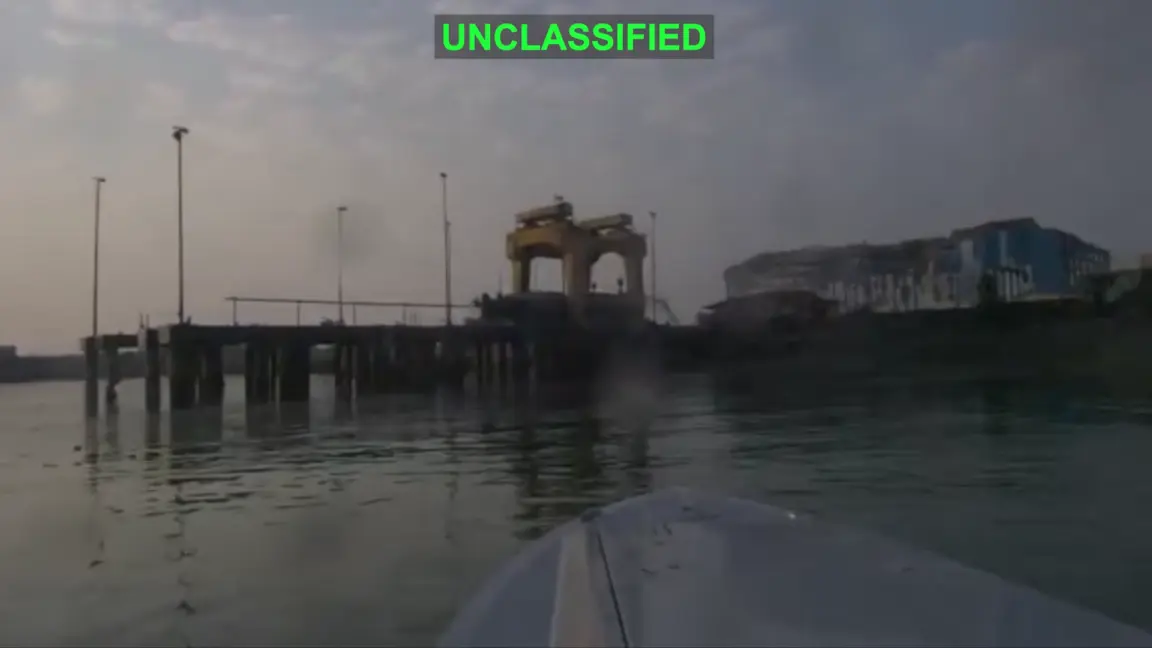
For the first time in its history, the U.S. military has sent explosive-laden drone boats into combat, striking an Iranian midget submarine and a naval maintenance facility at Bandar Abbas Naval Base. The attack occurred on the night of July 12 and was documented in video footage released by U.S. Central Command. The military command described the strikes as 'the first time American forces have employed sea drones in combat operations.'
The three uncrewed boats, formally referred to as 'one-way attack surface drones,' made a low-speed, carefully controlled approach to their targets before detonating. According to initial reports, one of the targets was a Ghadir-class midget submarine, which was suspended from a gantry and out of the water when the drone boat reached it. The submarine is one of Iran's small coastal submarines designed for operations in the Persian Gulf, and hitting it while it was dry-docked or under maintenance caused especially severe damage.
Key facts
- The U.S. military deployed explosive-laden drone boats in combat for the first time on July 12.
- Three one-way attack surface drones struck an Iranian Ghadir-class midget submarine and a naval maintenance facility at Bandar Abbas Naval Base.
- The drone boats were Saronic Corsair autonomous surface vessels, 24 feet long with a payload capacity of 1,000 pounds and a range of 1,000 nautical miles.
- U.S. Central Command confirmed that this was the first use of sea drones in U.S. combat operations.
- Earlier in the war, the same type of drone boat rescued two U.S. Army helicopter pilots.
- The United States is following a path first taken by Houthi forces in 2017 and later expanded by Ukraine.
The Corsair drone boats and their capabilities
The vessels used in the strike are Saronic Corsair autonomous surface vessels, built by Saronic Technologies, a defense company based in Austin, Texas. The Corsair is a 24-foot uncrewed surface vessel capable of carrying up to 1,000 pounds of payload over 1,000 nautical miles. Its top speed exceeds 34 knots, giving it a useful combination of range, speed, and payload capacity for maritime strike missions.
According to the company, the Corsair can operate autonomously without direct human control. It supports long-range navigation and patrol and can regulate power consumption and engine use to maintain position or loiter in a designated area. That autonomy is valuable in contested environments because it reduces the need for continuous communications with human operators, which could be jammed or intercepted.
For this strike, the Corsair vessels were likely loaded with explosive warheads and configured to act as guided munitions. The relatively small size of the boats made them difficult to detect on radar, especially at night and at low speed. The 'low-speed, uncontested approach' described in early reports suggests that Iranian coastal defenses either did not detect the incoming drone boats in time or were unable to engage them before detonation.
The use of the Corsair in combat is a major milestone for Saronic Technologies and for the broader push by the U.S. military to integrate uncrewed maritime systems into frontline operations. Drone boats are cheaper than many traditional missiles and warship-based weapons systems, and they allow commanders to place explosive power near a high-value target without risking crew members. The U.S. military has experimented with autonomous surface vessels for years, but this is the first confirmed combat use.
Why Bandar Abbas matters
Bandar Abbas is the site of Iran's main naval base on the Persian Gulf. It hosts a large portion of Iran's small-boat fleet, submarines, and missile patrol craft. Ghadir-class submarines are among the smallest submarines in service with the Iranian Navy. They are designed to operate in shallow water and can be used to lay mines, insert special forces, or fire anti-ship missiles from hidden positions. By striking one while it was out of the water, the U.S. military avoided the difficulty of attacking a submerged target and instead destroyed a major asset in a way that is difficult for Iran to rapidly replace.
Earlier drone boat rescue mission
This strike was not the first time the Corsair had been used by the U.S. military during the current war, although it was the first combat mission. In June, a Corsair sea drone rescued two U.S. Army helicopter pilots in the waters off the coast of Oman. The two pilots had been forced to land in the water after their AH-64 Apache helicopter was shot down by an inexpensive Iranian Shahed drone. The drone boat reached the pilots and supported their recovery, demonstrating that the same platform can be used for both combat and noncombat missions.
That rescue mission highlights the dual-use nature of uncrewed surface vessels. The same hull and autonomous navigation system that can carry an explosive payload into a defended anchorage can also be fitted with sensors, flotation devices, or other equipment for search-and-rescue. This versatility is one reason the U.S. military and other navies are investing heavily in such vessels.
A history of drone boat violence
The United States is not the first country to use exploding drone boats in combat. The first confirmed use of a kamikaze or suicide drone boat occurred on January 30, 2017, when the Houthi movement based in Yemen struck the Royal Saudi Navy frigate Al Madinah with an uncrewed remote-controlled boat. The attack was a wake-up call for naval forces around the world, as it showed that small, inexpensive, and largely off-the-shelf technology could threaten a modern warship. Western military officials later said the Houthi weapon was likely developed with technical assistance from Iran, which has long supported the group.
Since then, drone boats have become a staple of asymmetric maritime warfare, particularly in the Red Sea, the Persian Gulf, and the Black Sea. Houthi forces have continued to use explosive-laden unmanned surface craft against shipping and naval vessels, while Iranian forces have been accused of supplying such technology to allied groups across the Middle East.
Ukraine has also transformed drone boat warfare on a much broader scale. After Russia launched its full-scale invasion in February 2022, Ukraine, which had no traditional navy capable of challenging Russia's Black Sea Fleet, developed a series of uncrewed surface vessels and used them to strike Russian warships, tankers, and infrastructure. These attacks forced Russia to withdraw many of its naval assets from the western Black Sea and shift them to bases farther from Ukrainian-controlled areas. Ukrainian drone boats have also been used to interdict Russian shipping and to strike critical bridges and port infrastructure.
Ukrainian forces have achieved several military firsts with drone boats. They have used drone boats to launch missiles at Russian helicopters, proving that a small, fast uncrewed surface vessel can be used as an air-defense or ground-attack platform. They have also used drone boats to deploy small flying drones, allowing surface vessels to act as motherships for aerial reconnaissance and strike drones. In an even more unusual operation, a Ukrainian drone boat deployed an armed ground robot onto contested coastal territory, marking the first time an uncrewed surface vessel delivered a land robot into an amphibious combat operation.
The broader war and the turn to low-cost drones
The U.S. drone boat strike came in the midst of a much wider conflict. The war between the United States and Iran, supported by Israel, began on February 28, 2026, after years of rising tensions. The conflict has included airstrikes, missile exchanges, naval combat, and cyber operations. A cease-fire was attempted at one point, but it collapsed, and President Donald Trump has since ramped up military operations against Iranian forces and infrastructure.
The July 12 strikes were part of a broader set of attacks by conventional U.S. military forces, including fighter aircraft and warships, targeting Iranian military positions in recent days. The drone boat attack was intended to degrade Iran's small-submarine capability and its ability to maintain and repair naval vessels at Bandar Abbas, one of the most important naval bases in the country.
The use of drone boats by the U.S. military also fits a broader pattern of the United States adopting tactics first developed by nonstate actors or smaller military powers. In the same conflict, the U.S. military has used one-way aerial attack drones called LUCAS drones, which are based in large part on Iranian-designed Shahed drones. These inexpensive aerial drones can be produced in large numbers and are being used for strikes against Iranian air defenses, radar sites, and other targets.
This shift toward low-cost drones comes after the U.S. military lost dozens of expensive hunter-killer MQ-9 Reaper drones during the war. The Reapers, each valued at tens of millions of dollars, proved vulnerable to Iranian air defenses and electronic warfare systems. As a result, U.S. military planners are trying to procure a new generation of cheaper surveillance and strike drones. The drone boat strike is part of this same philosophical shift: instead of relying on increasingly expensive platforms, the military is using smaller, cheaper, and often uncrewed systems that can be massed in ways that overwhelm enemy defenses.
The implications of this shift are significant. If the U.S. military is now using disposable drone boats in its own combat operations, the move is likely to encourage further investment in uncrewed maritime systems not only by the United States but also by allies and partners. The same technology could be used to protect ports, escort ships, patrol coastlines, or conduct strikes in future conflicts. The Corsair strike at Bandar Abbas will likely be studied for years as an example of how uncrewed surface vessels can be used offensively in a crowded maritime environment.
Source: Ars Technica News