

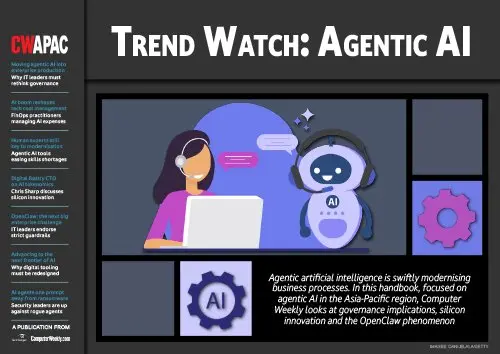
Agentic artificial intelligence (AI) is rapidly reshaping business processes across industries. Unlike traditional AI systems that respond to specific commands, agentic AI can autonomously plan, reason, and execute tasks to achieve goals. This shift from reactive chatbots to proactive digital agents promises to unlock new levels of efficiency and innovation. For organizations in the Asia-Pacific region, the adoption of agentic AI brings both tremendous opportunities and significant governance challenges.
Moving agentic AI from innovation theatre to enterprise production
As enterprises move beyond pilot projects, IT leaders are grappling with how to deploy agentic AI at scale. The leap from prompting chatbots to orchestrating multiple AI agents requires a fundamental rethinking of IT architecture. Data must be unified and accessible, governance frameworks must be robust, and cost management must be proactive.
One of the biggest hurdles is avoiding chaotic deployments. Without proper oversight, agents can make decisions that conflict or spiral into unintended consequences. For example, an agent tasked with optimizing supply chain logistics might autonomously change order quantities without human approval, causing inventory mismanagement. To prevent such scenarios, organizations are establishing human-in-the-loop workflows and setting strict boundaries on agent autonomy.
Another critical concern is cloud cost management. Agentic AI can generate significant compute demands, especially when agents engage in lengthy reasoning chains or repeatedly call large language models. If left unchecked, cloud bills can skyrocket. FinOps teams are stepping up to track token usage, optimize model selection, and align AI spending with business outcomes.
Despite these challenges, early adopters in APAC are reporting productivity gains in areas like customer service, software development, and business process automation. The key is to approach agentic AI with a strategic mindset: start small, monitor closely, and iterate based on real-world feedback.
How the AI boom is reshaping tech cost management
The rapid adoption of AI, particularly generative AI and agentic systems, is forcing a transformation in how organizations manage technology costs. Traditional FinOps practices focused on cloud infrastructure like compute and storage. Now, practitioners must account for the variable costs of tokens, API calls, and model inference.
In APAC, where many firms are price-sensitive due to regional economic pressures, cost optimization is paramount. FinOps teams are developing new metrics to measure the return on AI investments. For example, they track the cost per successful transaction or the cost per completed agent task, rather than just raw compute hours.
Furthermore, there is a growing emphasis on aligning cost-saving measures with sustainability goals. Energy-efficient model architectures, smaller specialized models, and edge inference can reduce both expenses and carbon footprint. Some organizations are experimenting with hardware accelerators designed specifically for AI workloads, such as GPUs and custom silicon like the OpenClaw chipset, which promises higher performance per watt.
The OpenClaw phenomenon has caught the attention of industry analysts. This open-source hardware initiative aims to create a standard for AI accelerators that can be locally manufactured, reducing dependency on global supply chains. For APAC enterprises, this could lower costs and improve resilience, but it also requires new expertise in hardware integration and driver development.
Governance remains a central theme. Without clear policies, AI agents can autonomously make purchases, allocate resources, or modify code, leading to budget overruns or security breaches. Companies are implementing financial guardrails that cap agent spending and require human approval for high-value actions.
Agentic AI speeds up mainframe modernisation, but human experts remain key
Mainframe modernisation is a long-standing challenge for many large enterprises, especially in banking, insurance, and government sectors in APAC. These organisations often run mission-critical applications written in legacy languages like COBOL, and the pool of skilled COBOL programmers is shrinking rapidly. Agentic AI offers a potential solution.
AI agents can analyze legacy code, document business logic, and generate equivalent modern code in languages like Java or Python. They can also simulate test cases to ensure functionality is preserved. This accelerates the migration process significantly, reducing months of manual effort to weeks.
However, early projects reveal that human expertise remains indispensable. AI agents may misinterpret complex business rules or overlook subtle dependencies that have built up over decades. An experienced mainframe analyst must review the AI’s output, validate assumptions, and correct errors. The best approach is a partnership: agents handle the repetitive, pattern-based work while humans focus on exception handling and architectural decisions.
Moreover, the cultural and organizational aspects of mainframe modernisation cannot be ignored. Many senior developers are wary of AI replacing their jobs, but when presented as a tool that reduces drudgery, adoption increases. Successful programs engage legacy experts early in the process, using their knowledge to train and guide the AI models.
In the APAC context, where many firms operate with tight budgets and aggressive digital transformation timelines, agentic AI offers a pragmatic path forward. Rather than a complete rewrite, organizations can incrementally modernize their mainframes, prioritizing the most critical and costly-to-maintain modules first.
The combination of agentic AI, skilled human oversight, and robust governance creates a powerful recipe for modernisation that balances speed, cost, and reliability. As the technology matures, the role of the human expert will shift from writing code to guiding AI agents – a new skill set that IT leaders must start cultivating today.
Source: Computerweekly News