

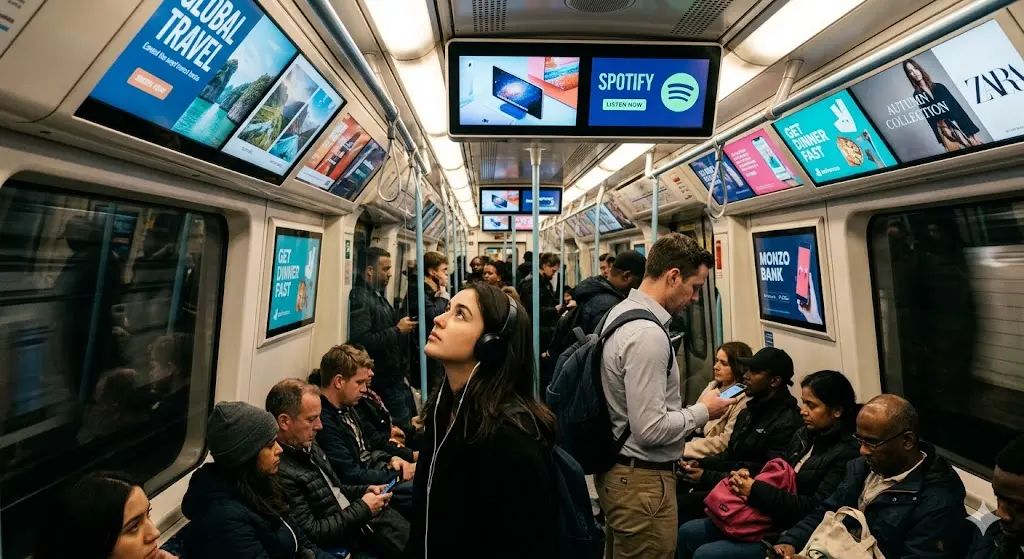
Public transportation is no longer just a mobility system—it’s becoming a powerful engine for digital advertising innovation. Why public transportation is transforming digital advertising worldwide comes down to one simple shift: millions of people are now a captive, mobile, and highly measurable audience in transit environments.
If you’ve noticed digital screens on buses, trains, and stations, you’re already seeing this transformation in action. It’s not random placement—it’s a structured evolution of how attention is captured in real-world movement spaces.
Public transportation is transforming digital advertising by creating high-visibility, location-based, and data-driven ad environments. In 2026, transit systems are becoming major digital media channels where brands reach urban audiences in real time.
What Is Digital Advertising in Public Transportation?
Definition Box:Transit-based digital advertising refers to the use of digital screens, mobile connectivity, and data systems in public transport environments to deliver targeted marketing messages.
This includes ads displayed in buses, trains, subway stations, and ride-sharing hubs.
Here’s the thing. Advertising used to rely heavily on static billboards and online clicks. Now it follows people through movement itself.
I’ve seen campaigns perform better in transit spaces than online display ads simply because attention is less fragmented when people are commuting.
Why Public Transportation Matters for Digital Advertising in 2026
In 2026, attention is the most valuable currency in advertising. And public transportation offers something the digital world often struggles to maintain—undivided attention for short but repeated intervals.
What most people overlook is how predictable commuter behavior actually is.
People follow the same routes, at the same times, every day. That repetition creates powerful advertising exposure cycles.
Let me be direct. A commuter may ignore an online ad in half a second, but they can’t easily ignore a screen in front of them for 15 minutes during a train ride.
Another major shift is data integration. Transit systems now collect anonymized movement patterns, allowing advertisers to understand audience flow in ways traditional outdoor ads never could.
Expert Tip
Transit advertising works best when messaging is simple, repeated, and visually dominant because commuters process information in short attention bursts.
How Public Transportation Is Reshaping Digital Advertising Step by Step
The transformation of advertising inside public transport systems follows a clear sequence of technological and behavioral changes.
Step 1: Digitization of Transit Infrastructure
Traditional posters are replaced with digital screens and connected display systems inside stations, buses, and trains.
This allows dynamic content updates instead of static messaging.
Step 2: Integration of Real-Time Data
Transit authorities and advertisers begin using real-time passenger flow data.
This helps match ad content with time, location, and commuter density.
Step 3: Programmatic Advertising Adoption
Ads are no longer manually scheduled. Instead, they are automatically placed based on audience behavior patterns and availability of screen space.
Step 4: Mobile and Transit Synchronization
Advertising begins to connect transit screens with mobile devices.
A commuter might see a message in a station and later receive a related digital ad on their phone.
Step 5: Behavioral Optimization
Campaigns are continuously refined based on engagement metrics like dwell time, route frequency, and station traffic.
Common Mistake or Misconception
A common misconception is that transit advertising is just digital billboards on wheels. In reality, it is a fully integrated ecosystem that combines mobility data, audience segmentation, and synchronized messaging.
What Research Reveals About Transit-Based Digital Advertising
Research in urban media behavior shows that commuters are significantly more receptive to repeated visual messaging during transit compared to other environments.
One key finding is that exposure frequency matters more than complexity of content in transit spaces.
Another insight is that transit audiences are highly diverse but behaviorally predictable. People from different economic backgrounds often share the same commuting corridors, making transit advertising unusually broad in reach.
At least from what I’ve observed in media planning discussions, brands often underestimate how long people actually spend in transit environments. That “hidden attention time” is where campaigns quietly gain impact.
There’s also growing evidence that transit ads improve brand recall even when users are not actively engaging with devices.
Unexpected Insight: Less Interactivity Can Increase Impact
Here’s something that surprises a lot of advertisers.
Transit ads often perform better when they are less interactive.
That goes against the usual digital marketing assumption that more engagement features equal better performance.
But in transit environments, simplicity wins because attention is fragmented and movement-based. A clear, bold message sticks more than a complex interactive experience.
Real-World Example: Metro Advertising Ecosystem
Imagine a large metro system in a busy city.
Digital screens display different ads depending on the time of day—morning commuters see coffee and productivity messages, while evening commuters see food delivery or entertainment content.
Over time, advertisers refine campaigns based on which stations generate the most attention.
What started as simple screen placement evolves into a fully adaptive advertising network tied to commuter behavior.
The result is higher brand recall and more efficient ad spending compared to traditional static placements.
What Actually Works in Transit Digital Advertising
Successful transit advertising depends heavily on timing, clarity, and repetition.
Campaigns that perform best tend to avoid complexity. Instead of long messages, they use short, bold visual cues that commuters can absorb quickly.
Another factor is contextual relevance. Ads that align with time of day or commuter mindset tend to perform better.
From what I’ve seen in campaign performance reports, consistency across multiple transit touchpoints often beats isolated high-impact placements.
Expert Tip
Transit advertising effectiveness increases significantly when brands maintain message continuity across stations, vehicles, and mobile retargeting channels.
How Public Transportation Connects with Digital Ecosystems
Public transportation is no longer isolated from digital marketing systems.
It now connects with mobile advertising platforms, location-based services, and real-time analytics engines.
This creates a loop where physical movement influences digital targeting and vice versa.
The interesting part is how seamlessly this happens in the background. Commuters rarely realize that their movement patterns are shaping the ads they see later on digital platforms.
The Psychological Impact of Transit Advertising
Transit environments create a unique psychological state.
People are in transition—mentally between home and work, or between tasks. That makes them more receptive to simple, repetitive messaging.
Unlike home browsing or office environments, there are fewer distractions competing for attention in a controlled transit space.
That doesn’t mean ads are guaranteed to succeed. But it does mean attention quality is often more stable than in fragmented digital environments.
People Most Asked About Why Public Transportation Is Transforming Digital Advertising Worldwide
Why is public transportation important for advertising?
Because it provides consistent, high-visibility access to large and diverse commuter audiences across cities.
How does transit advertising differ from online ads?
Transit advertising relies on physical visibility and repetition, while online ads depend more on clicks and engagement.
Is digital transit advertising effective?
Yes, especially for brand awareness and recall due to repeated exposure during commuting routines.
What technologies power transit advertising?
Digital screens, real-time data systems, and programmatic ad platforms enable modern transit advertising.
Does transit advertising target specific audiences?
Yes, targeting is based on route data, station traffic, time of day, and commuter behavior patterns.
Why are commuters a valuable audience?
Because they experience repeated exposure in predictable environments, increasing message retention.
Final Thoughts on Why Public Transportation Is Transforming Digital Advertising Worldwide
Why public transportation is transforming digital advertising worldwide ultimately comes down to attention, movement, and data convergence. Transit systems have evolved into powerful communication channels where digital advertising meets real-world behavior patterns.
As cities become more connected and commuter data becomes more refined, transit environments will continue shaping how brands reach audiences in everyday motion.
Our network platform helps brands and agencies amplify visibility in this evolving ecosystem. By combining press release distribution services with professional digital marketing services, businesses can improve SEO ranking, build high authority backlinks, increase organic traffic, and achieve stronger brand visibility through instant publishing and targeted media coverage strategies.