

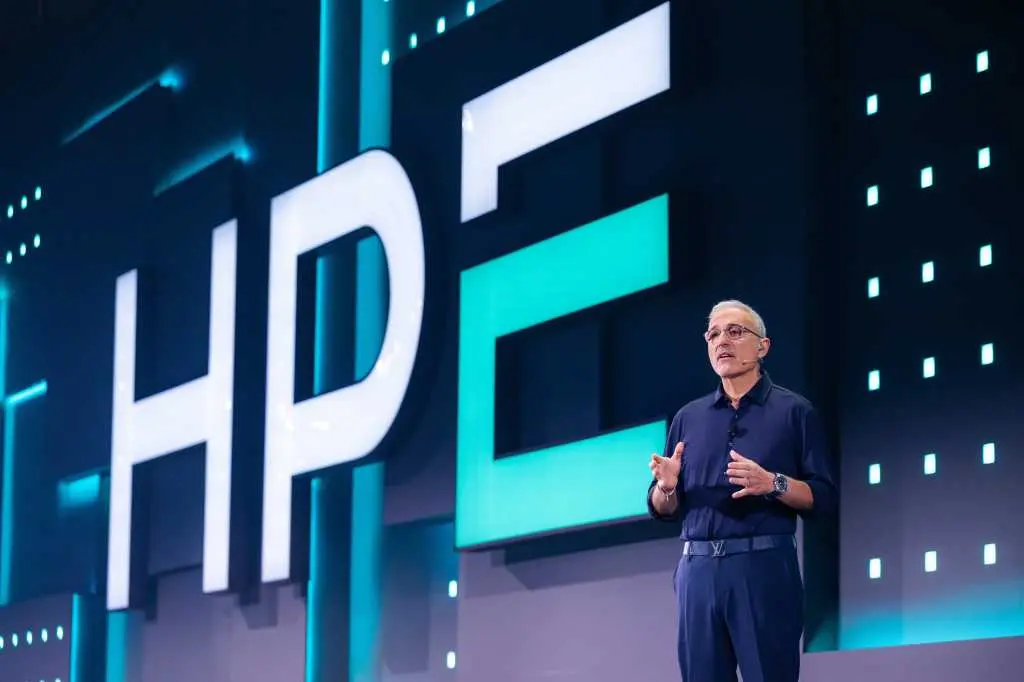
Hewlett Packard Enterprise is making a decisive bet on artificial intelligence, with CEO Antonio Neri using the company's annual Discover conference in Las Vegas to lay out a full-stack architecture purpose-built for the age of AI agents. The message was clear: AI is no longer just about training models in the cloud; it is about running autonomous agents alongside human users, demanding a fundamental rethinking of networking, compute, storage, and operational governance.
"Today, we are witnessing one of the largest technology platform shifts in history," Neri declared during his opening keynote. "Workloads and applications are moving from being driven by end users [to] now being driven by both end users and AI agents." This shift, he argued, requires an infrastructure that can handle the unique demands of agentic workloads—low-latency inference, real-time data retrieval, policy-driven execution, and massive scalability.
The Network as the AI Foundation
For HPE, the network is the bedrock of any AI strategy. "Every byte, every token, every decision, all of it crosses the network," Neri said, emphasizing that even microsecond delays can compound into weeks of lost training time when scaled across thousands of GPUs. The company's networking portfolio, now deeply integrated with Juniper Networks following the acquisition, was a central theme of the keynote.
HPE structured its networking offerings into four layers: scale-up within a single rack, scale-out across GPU clusters, data center interconnect, and edge inference routing. On the scale-up and scale-out front, new QFX switches provide the high-bandwidth, low-latency connectivity required for GPU-to-GPU communication. For data center interconnect, the PTX 12,000 routing platform delivers 800G routing, enabling fast and efficient movement of training data between facilities. Security is addressed by the SRX 4700, a quantum-safe firewall capable of 1.44 Tbps throughput in a single rack unit—critical as AI workloads become prime targets for adversaries. At the edge, the MX 301 router brings the MX platform to inference locations, powered by Juniper's sixth-generation Trio silicon.
The cost of latency in AI training cannot be overstated. Neri illustrated the point with a stark comparison: "Multiply a small delay across hundreds of thousands of GPUs over weeks of training in your network can mean the difference between training a new model in 90 days or 30 days. It is the difference between chasing a breakthrough or making one." This emphasis on network performance reflects HPE's strategy to differentiate through integrated, end-to-end solutions rather than piecemeal components.
Compute for the Agentic Era
While networking connects the pieces, the compute systems themselves must be optimized for AI. HPE organized its compute portfolio into three AI Factory tiers: one for enterprise deployments, one for service providers, and one for sovereign environments. Each tier is designed to accelerate time-to-token and reduce execution risk, according to Neri.
The star of the compute announcements was the new ProLiant DL 394 Gen 12, purpose-built for agentic AI and long-context workloads. At the highest AI Factory at Scale tier, new configurations can deliver training with one-quarter the GPUs required by the previous Blackwell-generation platform, while inference costs drop to one-tenth per million tokens. This represents a significant leap in cost efficiency, making AI more accessible to a broader range of enterprises.
Private Cloud AI, HPE's integrated AI platform now co-developed with Nvidia, has been expanded to scale up to 256 GPUs with multi-node inference. A unified gateway provides a single API for accessing both frontier models and open-source alternatives, while a shared cache reduces the cost per first token by avoiding redundant computations. "Private Cloud AI can now serve larger models across multiple systems with multi-node inference, so capacity grows with the math," Neri explained.
Storage: The Foundation for Intelligent Agents
Agents are only as capable as the data they can access. To that end, HPE introduced the Alletra MPX 10,000 as the storage layer for Private Cloud AI. This system unifies file and object storage on a single architecture, eliminating the silos that typically plague enterprise data environments. It adds real-time metadata enrichment and native support for the Nvidia MCP (Model Context Protocol), enabling agents to retrieve data across both structured databases and unstructured repositories like documents and logs.
Neri claimed that this integrated approach delivers 7 to 12 times faster time-to-value compared to custom-built environments. "Your AI agents are only as smart as the data you use to train them," he said. "Traditionally, that data required custom preparation for every use case and months of building the right AI data pipelines, but not anymore." The Alletra MPX 10,000 also carries Nvidia Certified Storage validation, ensuring compatibility and performance for GPU-accelerated workloads.
Agentic Operations and Governance
Perhaps the most forward-looking part of the keynote focused on how to manage the explosion of AI agents within enterprises. Neri noted that agents are already proliferating—often built by developers and small teams outside formal IT oversight—creating governance and security challenges. "Agentic AI demands a new set of enterprise requirements," he said.
HPE's answer is a governed agent layer built into Private Cloud AI. Enterprises can register agents built in any framework (e.g., LangChain, LlamaIndex, or custom code), then apply security controls on API calls, identity, and encryption—all with zero code changes required. A three-tier identity model verifies the human user, governs the agent's permissions, and requires human approval for sensitive actions such as writing to databases or executing financial transactions.
Backing this up are several Nvidia-integrated technologies. Nvidia Open Shell provides isolated, policy-enforced runtime environments for agents, preventing them from escaping their designated scope. Nvidia NeMo Cloud offers governed workflow blueprints, enabling enterprises to standardize agent behaviors. And Zerto, the HPE-owned disaster recovery solution, provides clean-state rollback: if an agent makes an error or causes unintended consequences, systems can be reverted to a known good state instantly.
On the cloud management front, HPE CloudOps consolidates virtualization, data protection, and cloud management into a single hybrid operating layer. The Unleash AI program has also grown to include more than 60 validated partners, providing pre-integrated solutions for everything from data preparation to deployment.
The Power Challenge
No discussion of AI infrastructure would be complete without addressing the elephant in the data center: power consumption. Neri warned that the United States faces a 19-gigawatt power gap by 2028, with data centers projected to account for nearly half of U.S. electricity demand growth through 2031. "Every model, every workload, every agent depends on power, because at its core, an AI factory is doing one thing: turning electrons into tokens," he said.
HPE's approach to efficiency spans the entire stack. The new ProLiant servers use advanced cooling technologies, including direct liquid cooling options for high-density GPU configurations. The Alletra MPX 10,000 is designed for high storage density with minimal power overhead. And the networking gear, particularly the PTX 12,000 and QFX switches, leverages silicon advancements that deliver more bandwidth per watt. "As AI scales, the future will not be defined by compute alone," Neri concluded. "It will be defined by how efficiently we can power it, cool it, and connect it."
The broader industry context reinforces this urgency. Major cloud providers are already competing for access to renewable energy sources, and many enterprises are exploring modular or edge data centers that can be deployed closer to generation sources. HPE's emphasis on efficiency and integrated design positions it to help customers navigate these constraints while still achieving their AI ambitions.
With these announcements, HPE is clearly aiming to be the infrastructure provider of choice for the agentic era. From the network to the storage to the governance layer, the company is weaving together acquisitions like Juniper and Zerto with organic innovation to create a cohesive platform. Whether enterprises will embrace this integrated vision or continue to patch together best-of-breed components remains to be seen, but Neri made a compelling case that the complexity of AI agents demands a unified approach.
Source: Network World News