

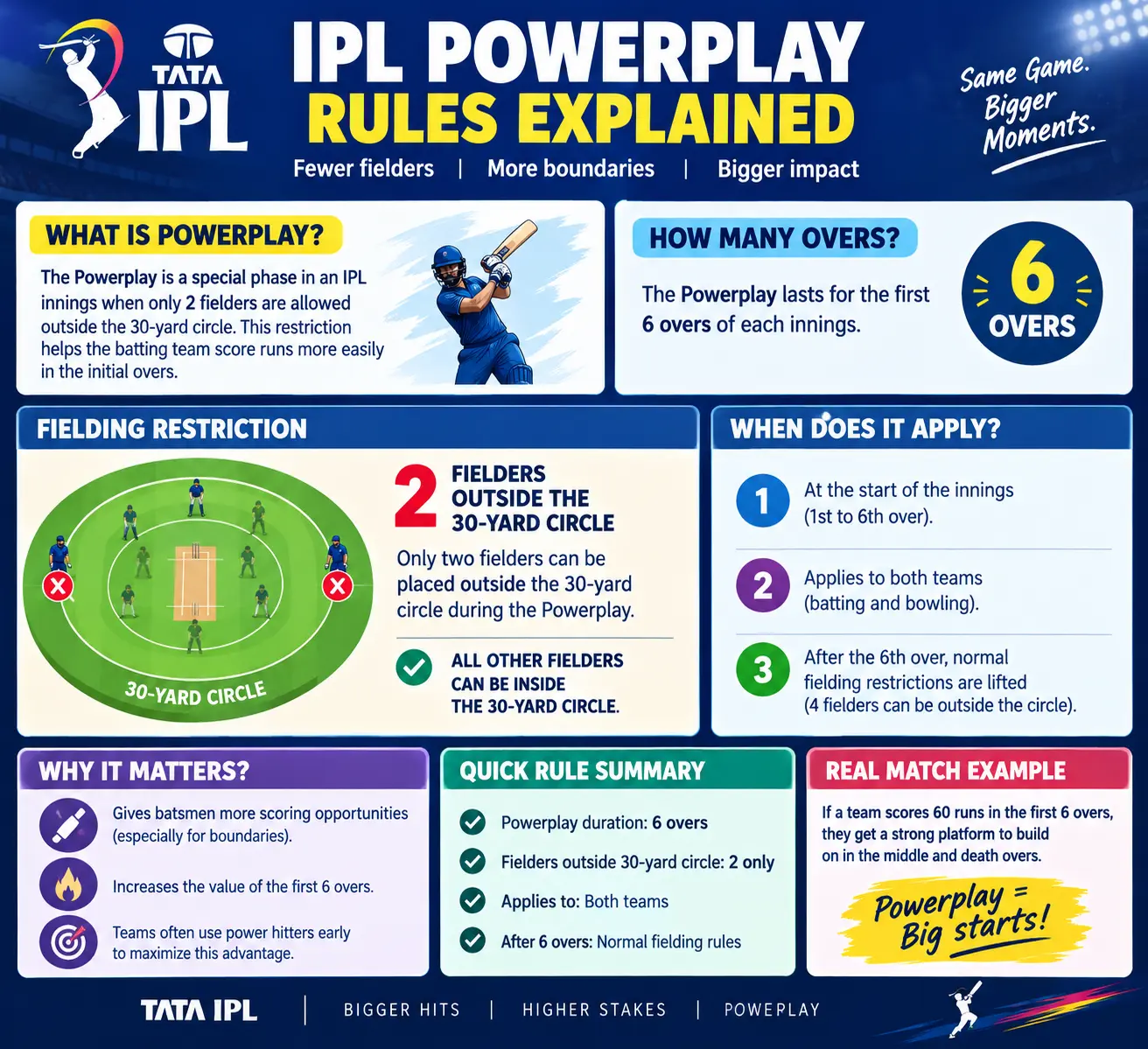
The Indian Premier League (IPL) is cricket's most-watched T20 competition, and within every IPL innings there is a window of concentrated drama: the powerplay. Those first six overs — with fielding restrictions in force — routinely decide the shape of the contest, from the platform a batting side builds to the psychological blow a bowling attack can land. Understanding the powerplay rules, the strategy behind them, and their measurable impact on match outcomes is essential for any serious IPL fan, fantasy player, or analyst.
This guide explains exactly how the IPL powerplay works, how it compares with other formats, why teams treat it as a distinct phase of the game, and what the data says about its influence on results.
1. What Is a Powerplay in Cricket?
A powerplay is a defined block of overs during which the fielding side is restricted in how many fielders it may place outside the 30-yard inner circle. The concept was introduced by the ICC in 2005 to encourage attacking batting: fewer fielders on the boundary means bigger gaps, more scoring opportunities, and a premium on innovative shot-making.
The term has since become central to limited-overs vocabulary. In the IPL, "powerplay" specifically refers to the opening six overs of each innings — the phase in which only two fielders are allowed outside the 30-yard circle. From the seventh over onward, up to five fielders may patrol the boundary.
2. The Exact IPL Powerplay Rules
The IPL follows the standard men's T20 international powerplay framework. The key rules are:
· Duration: Overs 1–6 of each innings constitute the powerplay. The batting side faces exactly six overs of restricted fields under normal conditions.
· Fielding restriction: A maximum of two fielders may stand outside the 30-yard circle at the moment the ball is delivered.
· After the powerplay: From over 7 to over 20, the limit rises to five fielders outside the circle.
· No discretion: Unlike older ODI formats where captains could choose when to take a powerplay, the T20/IPL powerplay is fixed at the start of the innings. There is no second powerplay.
· No-balls for breaches: If a third fielder is outside the circle when the ball is bowled, the umpire calls a no-ball, and the batting side receives a free hit on the next delivery — a heavy punishment for a tactical error.
· Rain-reduced innings: If overs are lost to weather, the powerplay shrinks proportionally. Since July 2025, the ICC calculates the reduction to the nearest ball rather than the nearest over, which slightly alters shortened-game powerplay lengths.
Within the powerplay, captains may still arrange their two permitted boundary fielders wherever they wish — deep point, long-on, fine leg, or sweeping covers — and may keep the other nine players inside the circle, including slip fielders early on. The restriction is on where fielders stand, not on bowling changes or fielding positions inside the circle.
3. Why Only Two Fielders Outside?
The number two is deliberate. With nine fielders inside a circle that is roughly 27–30 metres in radius, gaps exist for quick singles and sharp placement, but boundary shots must be hit past two specifically positioned defenders. Research into scoring patterns shows that powerplay overs in T20 cricket produce higher scoring rates and a greater share of boundaries than any other phase with comparable bowling quality — precisely because attacking fields reward clean striking.
The two-fielder limit also forces captains into a resource allocation puzzle: which two areas of the ground are most dangerous to leave open? Against a batter who scores heavily square of the wicket, a captain might place both boundary fielders square; against a straight hitter, they may protect long-on and long-off. The restriction thus creates a cat-and-mouse tactical battle between captain and batter from the very first ball.
For bowlers, the powerplay demands precision. Bowlers who miss their length provide boundary opportunities with almost no margin for error. Data from IPL seasons consistently shows powerplay economy rates higher than middle-over economy rates for the same bowlers — the field simply doesn't allow containment without accuracy.
4. How the First Six Overs Change a Match
The influence of the powerplay on IPL outcomes is measurable and substantial.
Setting or Derailing a Total
A strong powerplay — 50-plus runs without losing a wicket — gives a batting side the platform to play out the middle overs calmly and attack the death. A poor one — 30 for 2 — forces the middle order to rebuild under pressure, often costing 15–25 runs against par. Studies of T20 innings show that the difference between a 60-run powerplay and a 40-run powerplay correlates with total-score differences of similar magnitude later on, because early wickets curtail risk-taking throughout the innings.
Chasing Games
In chases, the powerplay is even more decisive. Analysis of IPL chases found that the number of wickets lost by the sixth over correlates strongly with win probability — each early wicket measurably reduces the chasing side's chances. Conversely, a team that takes 30% or more of its target during the powerplay stays close to the required rate and can absorb a wicket without losing control. The best chasing templates, according to ESPNcricinfo's modelling, use overs 3–6 to score 0.1–0.2 runs per ball above the asking rate after a cautious opening couple of overs.
Momentum and Matchups
The powerplay is when captains establish matchups: promoting a pinch-hitter to attack a particular bowler, bowling a spinner in the sixth over to surprise an attack-minded batter, or using a fastest bowler against an opener who struggles against pace. Winning these early duels shifts win probability visibly — a powerplay wicket of a set opener can swing the model by 10–15 percentage points in a balanced game.
The Psychological Edge
Beyond numbers, the powerplay shapes mood. A boundary-laden start energises the dugout and the crowd; a cluster of dot balls and a lost wicket silences it. Research on momentum in cricket suggests that early dominance affects subsequent decision-making — bowling sides that seize powerplays tend to maintain fielding intensity and attacking lengths through the middle overs.
5. Powerplay Batting Strategies in the IPL
IPL teams have developed several distinct powerplay approaches:
1. Full attack from ball one: Sending aggressive openers to hunt boundaries immediately, accepting the risk of early wickets. High-variance but high-reward — used extensively by teams with deep batting line-ups.
2. Settle-then-strike: The research-backed template — the first two overs are used to read the surface and preserve wickets, followed by aggressive scoring in overs 3–6 while the field remains up. This mirrors the four-phase chase model identified in ball-by-ball studies.
3. Targeted aggression: Identifying the bowling attack's weakest powerplay option and scoring heavily from their overs while taking fewer risks against the strike bowler.
4. Placement over power: Using the crowded inner ring to rotate strike and find gaps rather than clearing the boundary — effective on slower pitches where six-hitting is risky.
Bowling sides counter with plans of their own: opening with spin on turning tracks to surprise batters raised on the pace-first template; bowling wide of off stump to deny free scoring areas; and setting "attacking" fields with catching positions inside the circle, gambling that an early wicket is worth the boundary risk.
6. Powerplay Records and Benchmarks
Historical IPL data provides useful benchmarks:
· Elite powerplays in the IPL have exceeded 80 runs in six overs — rare explosions where openers attack from the first over against wayward bowling.
· Par powerplays on typical surfaces tend to sit in the 45–55 run range with at most one wicket lost.
· Troubled powerplays — below 35 with two or more wickets — usually leave a side playing catch-up; recovery is possible but statistically less likely.
· Highest powerplay scores in recent seasons have been posted by teams known for aggressive openers — sides like Sunrisers Hyderabad and Chennai Super Kings have topped phase charts through contrasting styles: raw power versus calculated placement.
These benchmarks help fantasy players and analysts judge whether a team is ahead or behind at the six-over mark — a phase score in isolation means little without pitch and target context, but against venue par it is highly informative.
7. Common Powerplay Mistakes
Even elite IPL sides make identifiable errors:
· Losing two wickets inside four overs: Attacks the hardest recovery scenario; win probability drops sharply.
· Failure to use the field: Batters who do not exploit the gaps in the inner ring waste the structural advantage the rules provide.
· Predictable bowling plans: Serving openers their preferred length and line through the powerplay without variation.
· Poor field placement: Leaving the batter's strongest scoring zone open while defending areas they rarely target.
· Ignoring match-ups: Persisting with a bowler whose numbers against the striker are poor, hoping form will trump data.
Analysing these mistakes through phase-by-phase data is one of the most productive uses of ball-by-ball archives for coaches and analysts.
8. How the IPL Powerplay Differs from Other Formats
The powerplay's meaning shifts across formats, and understanding the differences clarifies why IPL strategies are unique:
Format | Powerplay structure | Fielders outside circle |
IPL / T20 | Overs 1–6 only | Max 2 (overs 1–6); max 5 after |
ODI (men's) | Three blocks: overs 1–10, 11–40, 41–50 | 2, then 4, then 5 |
The Hundred | First 25 balls | Max 2 |
In ODIs, the opening powerplay lasts ten overs — double the IPL's — and the middle block already allows four boundary fielders, blending containment with attack. The IPL's six-over window concentrates the same tension into a shorter, more explosive phase, which is a major reason T20 openers are among the game's most valuable players.
9. What the Analytics Say: Is the Powerplay Really Decisive?
Quantitative studies of T20 cricket repeatedly find that:
· Powerplay run rate is among the strongest correlates of final totals, alongside death-over performance.
· Powerplay wickets disproportionately affect win probability in both innings — more so than wickets in the middle overs, because they rob the innings of time to rebuild.
· Chase success is tightly linked to powerplay efficiency: chasing sides that stay near the required rate through six overs win a far higher share of those games.
· Teams that treat the powerplay as a "phase to survive" rather than "a phase to win" tend to underperform their talent level across a season.
The conclusion from the data is consistent: the first six overs are not merely the start of the match — they are a distinct sub-contest whose scoreboard often predicts the final one.
10. Practical Takeaways for Fans and Analysts
When watching an IPL powerplay, track these markers:
5. Runs vs par: Is the side ahead of the venue's typical six-over score?
6. Wickets lost: Zero or one is healthy; two or more is a red flag.
7. Share of target (in chases): Has the team taken at least ~25–30% of the target?
8. Boundary count and dot balls: A high boundary count with few dots signals dominance; many dots with few boundaries signals trouble even if no wickets have fallen.
9. Matchup results: Who won the key duels — batter vs strike bowler, captain vs field placement?
10. Intent in overs 3–6: Winning sides typically lift their scoring once the initial settling period ends.
The IPL powerplay — six overs, two boundary fielders, and the full weight of modern T20 strategy — is one of the most consequential phases in any format of cricket. The rules are simple, but their effects are profound: they reward aggressive batting, punish imprecise bowling, and generate the early momentum swings that decide a large share of matches. Research consistently shows that teams who master the powerplay — whether by laying a platform in the first innings or protecting wickets in a chase — win more often. The next time the umpire calls "play" and the field spreads to just two men on the boundary, remember: the match, in a very real sense, is already being decided.