

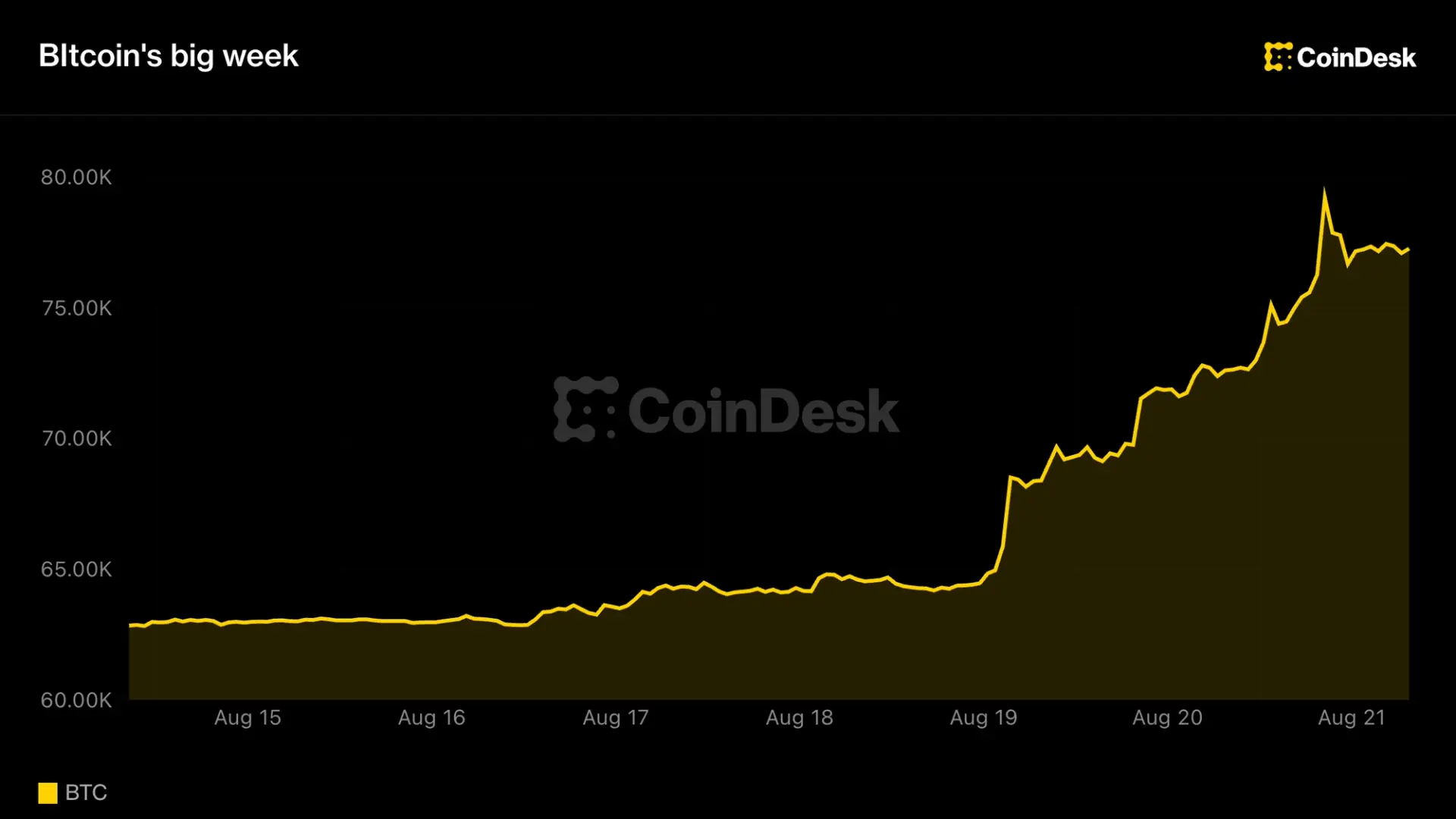
Bitcoin slipped back to around $77,000 on Friday after coming within a few dollars of $80,000 overnight, easing from the highs but still posting a weekly gain of more than $15,000. The asset remains up over 6% in the past 24 hours, extending a move that began earlier in the week from below $64,000. The pullback has been modest, and traders are now watching whether the rally can sustain its momentum into next week, particularly as institutional inflows continue to rise.
The strong move has been attributed to a combination of short liquidations, renewed ETF demand, and broader macroeconomic conditions. Bitcoin's market capitalization has pushed past $1.5 trillion, and it is now about 39% below its record high near $126,000 from October, meaning this is a recovery within a down year rather than new ground. The speed of the rally, however, has raised questions about sustainability, with some analysts warning that vertical moves can reverse just as quickly once momentum fades.
Altcoin rotation begins as bitcoin's rise may slow
Joshua Lim, head of derivatives at FalconX, said bitcoin's rise could slow from here, with traders rotating into altcoins that have missed much of the rally. The crypto asset is trading near $77,244 after leading the move higher from the $60,000 level that held for much of the summer. Lim said that strength could set up a “catch-up” trade in other cryptocurrencies.
Bitcoin Cash (BCH) is one example. Lim said traders are buying BCH for broader exposure to a rising crypto market. Strong price gains can also make weaker altcoin investment cases easier for portfolio managers and investment committees to defend. That rotation is already showing up in Friday's trading. Bitcoin Cash led the market with a 31% gain over 24 hours, while Ethena (ENA) rose 27%. Pudgy Penguin's native token, PENGU, and Pepe Coin (PEPE) gained roughly 20%.
Broader measures have yet to show a full altcoin season. Bitcoin dominance stands at 59.8%, down just 0.1 percentage point, while CoinMarketCap's Altcoin Season Index is 33 out of 100, down from 51 last week. Behind the rally, Lim sees a larger change taking shape. Bitcoin's role as a hedge against currency debasement has gained wider attention, while Treasury support for long-term bonds amounts to a form of easing, he said. Crypto has tended to benefit from easier financial conditions. Retail traders, Korean investors and traditional finance firms that had turned toward AI, stocks and commodities are also returning, Lim said.
But momentum brings risk. Lim warned that during periods of market euphoria, prices can outrun fundamentals, complicating decisions about price targets and when to cut exposure.
Ray Dalio: buy gold and bitcoin, sell bonds
Ray Dalio, founder of Bridgewater Associates, wrote on Friday that three recent events are consistent with what was laid out in his book, How Countries Go Broke: The Big Cycle: Japan's sale of U.S. government paper to support the yen and its capital markets, U.S. bond yields hitting new highs alongside dollar weakness, and Treasury Secretary Scott Bessent's attempts this week to lower or cap bond yields.
“I suggest diversifying well in asset classes and countries that have strong income statements and balance sheets and are not having great internal political and external geopolitical conflicts,” Dalio concluded. “Underweighting debt assets like bonds, and overweighting gold and a bit of bitcoin. Having a small percentage—maybe 10-15%—of one's money in gold can reduce a portfolio's risk, and I think it would also raise its return.”
His comments come as gold reached $4,600 an ounce, rising a further 2% over the past 24 hours, while silver approached $70 an ounce after gaining more than 2.5%. The simultaneous rally in bitcoin and precious metals highlights the growing narrative that hard assets are favored in an environment of fiscal expansion and potential monetary easing.
Fed rate hike bets rise as bond yields climb
What was a quiet session in the bond market has gotten far less so in the last couple of hours. Traders seem determined to put Treasury Secretary Scott Bessent to the test, pushing government bond yields up despite his efforts this week to jawbone interest rates lower.
The 30-year Treasury yield is now up four basis points for the day to 5.28%, with the 10-year yield up 3.5 basis points to 4.73%. The two-year yield is up a big 5.3 basis points to 4.24%. The short end of the curve is directly influenced by Federal Reserve policy, so the late-week jump in this yield suggests a rise in bets that the Fed will hike rates at one of its last three meetings of the year.
CME FedWatch now places the odds of a rate boost in September at more than 40%, up from just 33% one week ago. The odds of one or more Fed rate hikes at some point in 2026 have risen to 72%. Equity markets don't seem to mind. The Nasdaq and S&P 500 are both near session highs, each up 0.55%. Bitcoin remains higher by just shy of 7% over the past 24 hours at $77,300.
One month ago, traders had placed about a 90% chance of one or more Fed rate hikes by the end of the year. Expectations have been pared back, but traders are still betting on Fed rate hikes this year. According to CME FedWatch, odds for higher rates at the U.S. central bank's September meeting are just 35%, but odds for higher rates by year-end (there are additional policy meetings in October and December) are 66%.
Crypto-related stocks surge as bitcoin holds $77,000
The U.S. stock market was only marginally higher in early Friday trading, but crypto-related shares were outperforming as bitcoin held the $77,000 level. Robinhood (HOOD), where crypto-related trading had fallen off a cliff in the bear market, was higher by 12.5%. Coinbase (COIN) was ahead 9.2%, and Gemini (GEMI) was up 10%. Circle (CRCL) was higher by 9.2%, with Bullish (BLSH) up 6%, and Galaxy Digital (GLXY) up 4.6%. Strategy, now back in the green on its bitcoin holdings, was up 6%.
Bitcoin surged more than 6% over the past 24 hours, reaching an intraday high of $79,500 before pulling back. This lifted crypto-related stocks broadly. Strategy (MSTR), the world's largest corporate bitcoin holder, jumped 10%, while Coinbase and MARA Holdings (MARA) gained 6%. Galaxy Digital rose 5%.
ETF inflows surge for second straight day
U.S. spot bitcoin ETFs took in $606 million on Aug. 20, up from $517 million the day before, while ether ETFs pulled in $221 million, per SoSoValue data. Every listed asset drew inflows, with XRP funds adding $13 million and Solana $15 million, a second straight day of accelerating institutional buying behind bitcoin's breakout.
The flows answer the question hanging over the run. Bitcoin cleared $69,000 on Wednesday and pushed above $72,000 on Thursday, and the worry was whether the move was real demand or shorts getting squeezed. Two days of inflows this size, each bigger than the last, point to institutions chasing the break rather than a one-day liquidation spike doing all the work.
Standard Chartered's Geoff Kendrick said Friday morning that short liquidations are behind much of this week's big move higher in bitcoin. The next leg, he says, will be driven by buyers. Indeed, ETF inflows have already begun to pick up, but zooming out, says Kendrick, shows the move is rather small and just getting started. He expects to see a daily inflow of $1 billion at some point. “There is now a risk my end year forecast (of $100,000) is too low.”
Market analysts weigh in on the rally
“Nice momentum these last few days,” said Mati Greenspan, a former senior eToro market analyst, bitcoin maximalist and founder at Quantum Economics. “This is generally what bottoms look like. They begin with a short squeeze, a giant green candle, start breaking above technical levels and suddenly everyone with limit orders waiting for BTC to drop to $40,000 are now rethinking their strategy telling themselves: 'I better get onboard before I miss the boat.'”
Kendrick echoed the view that the move is likely just getting started. “Markets are reminding investors that volatility has two sides in digital assets,” he wrote. “We are starting to see (only starting) what happens when prices rise sharply.”
Data center names continue to slide
While crypto-related stocks rallied, data center names were hit hard again. “Politicians Who Once Championed Data Centers Are Now Bashing Them,” read an above-the-fold headline in the Wall Street Journal on Friday. With November quickly approaching, politicians across the country—on both sides of the aisle—have suddenly realized they can rack up votes by standing in the way of data center growth. The story mentions a new University of Pennsylvania poll showing more than 60% of Americans oppose new data centers, up from just 49% in March.
Investors in data center operators, most of whom have exited bitcoin mining, continue to sell. Hut 8 (HUT) was lower by another 8% on Friday and is now down by more than 40% since hitting a record high in early June. Shares do remain higher by about 60% year-to-date. Also continuing to give back gains: Cipher Mining (CIFR) was down 8.8%, TeraWulf (WULF) 5%, CleanSpark (CLSK) 5%, and IREN (IREN) 3.1%. With bitcoin possibly entering a new bull market, one wonders if next year's story might be data center players migrating back to BTC mining.
Other market developments
Citadel has cashed in on its Situational Awareness profits. “To date, we have successfully shed more than 80% of the aggregate risk from the original portfolio,” read a letter from Ken Griffin to Citadel investors. “We have completed nearly 100 block trades totaling over $4 billion in market value.” The panic in AI-related stocks last month forced previously hot-handed Leopold Aschenbrenner's Situational Awareness fund to cough up much of its holdings, with Citadel being the buyer. The resulting V-shaped recovery, which began within hours of the transaction, led to major profits for Citadel. The company's Wellington Fund closed July higher by 5.94%, bringing its year-to-date return to 12%.
Bitcoin Standard Treasury Company (BSTR), led by Blockstream co-founder and CEO Adam Back, and Cantor Equity Partners I (CEPO) mutually terminated their proposed business combination after attempting to negotiate revised terms, according to an Aug. 20 SEC filing. BSTR will pay CEPO $15 million in cash, while the associated private placements have been canceled. CEPO will search for another acquisition target, while Back and BSTR will continue pursuing active bitcoin treasury and yield strategies. “Despite current market conditions, we continue to see substantial demand for return on bitcoin, and we have spent the last year building the capability to deliver it,” said Back.
In the broader capital markets, Anthropic expects its planned IPO to match or exceed SpaceX's record, according to Bloomberg, and could file publicly as soon as the end of this month. SpaceX raised $75 billion at its debut in June, the biggest first-time share sale ever, a figure that rose to $86.2 billion once the overallotment option was exercised. Anthropic beating that would mark the largest IPO on record and underline how hard investors are chasing AI exposure. That competition for capital has run alongside crypto all year. The wave of AI listings, SpaceX first, then OpenAI and Anthropic filing behind it, pulled institutional money that might otherwise have found crypto, a dynamic that tracked bitcoin's worst ETF outflows in June. The timing now is the twist. Anthropic is lining up its mega-IPO in the same week bitcoin broke out past $75,000 on record ETF inflows, the AI and crypto bids running hot at once rather than at each other's expense.
Source: Coindesk News