
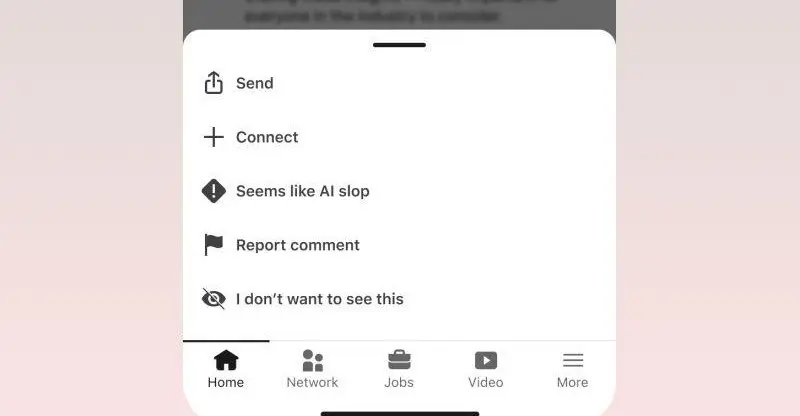
LinkedIn's new 'Seems like AI slop' button is apparently getting a lot of use. According to a Thursday post from chief product officer Hari Srinivasan, 'over a million people' have clicked on the button, which is accessible from the three dots menu on a post. The social network aimed at professionals introduced the feature on July 30 as part of a broader effort to combat the flood of AI-generated content that has been cluttering feeds.
The announcement comes just a few weeks after AI detector Pangram determined that 41 percent of LinkedIn's longform posts were flagged as fully AI generated, a finding that was widely discussed across the tech industry. LinkedIn's response included not only the AI slop button but also new and improved classifiers to identify posts as AI, and the removal of a feature that would 'enhance your post' with AI. Now, the platform is reporting early signs of success: users are seeing 40 percent fewer views on content that the platform classifies as AI slop.
How the AI Slop Button Works
The 'Seems like AI slop' button is embedded in the three dots menu that appears on every LinkedIn post. Users who encounter content that reads as generic, robotic, or heavily AI-generated can select this option to flag it. The label itself is informal, even humorous, but the underlying purpose is serious: reducing the visibility of low-effort, algorithmically produced posts that have become increasingly common on the platform.
Srinivasan described AI slop as a 'top priority for all of us,' acknowledging that the issue has been affecting user experience and trust. LinkedIn's move is part of a larger trend among social media platforms to develop tools and policies aimed at curbing AI-generated content, which can range from harmless productivity tips to misleading or spammy posts.
Why AI Slop Became So Pervasive
LinkedIn has long been a target for content creators and marketers looking to build their personal brands. The platform's encouragement of longform posts, hashtags, and engagement bait created an ideal environment for AI-generated material. With the rise of large language models like ChatGPT, users discovered they could produce polished-sounding articles, career advice, and thought leadership pieces in seconds. This led to an explosion of posts that often lacked personal experience or genuine insight.
The Pangram study highlighted the scale of the problem. By flagging 41 percent of longform posts as fully AI generated, it demonstrated that a significant portion of LinkedIn's most visible content was not coming from human expertise but from algorithms. This not only degrades the quality of the platform but also undermines the value proposition of LinkedIn as a place for authentic professional networking and knowledge sharing.
LinkedIn's Multifaceted Approach
LinkedIn's response has been more comprehensive than simply adding a feedback button. The company introduced improved classifiers that automatically detect AI-generated posts. These classifiers appear to be working, as evidenced by the 40 percent reduction in views on content flagged as AI slop. This reduction likely stems from changes in the recommendation algorithm, which now demotes or filters out content that the classifiers deem inauthentic.
In addition, LinkedIn removed a feature that allowed users to 'enhance your post' with AI. This feature had been seen as encouraging the very behavior the platform is now trying to curb. By eliminating it, LinkedIn removed an easy pathway for users to generate AI-assisted content directly within the platform.
The company is also introducing a new feedback message aimed at content creators. If a user makes a post that receives multiple flags, they may see a notification saying, 'Some members told us this post seems like AI.' This is designed to be educational rather than punitive. Srinivasan said, 'We approached this assuming good intent; I know I’m increasingly conscious on how to not sound like AI & the goal is to provide helpful feedback.'
Early Results and User Response
The fact that over 1 million people have clicked the AI slop button suggests that users are eager to help clean up the platform. It also indicates that the problem is widespread enough that many people encounter suspected AI content regularly. The 40 percent reduction in views on classified AI slop is a promising metric, though it is only an early indicator. LinkedIn will need to monitor whether this trend continues and whether the classifiers become more accurate over time.
Some users have expressed concern that the system could be misused, with competitors or critics flagging legitimate posts to suppress them. Others worry that the classifiers might be too aggressive, inadvertently punishing human-written content that happens to use phrases or structures commonly associated with AI. LinkedIn has not disclosed the specific thresholds used by the classifiers, but the company has emphasized its commitment to handling the issue carefully.
The feedback message to creators represents a compromise between transparency and accountability. By notifying users that their content has been flagged, LinkedIn gives them the opportunity to adjust their approach or explain why their post is genuine. This aligns with the company's stated philosophy of assuming good intent.
Broader Context: AI Content Moderation
LinkedIn's efforts are part of a wider industry movement to address the proliferation of AI-generated content. Platforms like Facebook, Twitter (now X), and Reddit have all grappled with how to handle bots, AI-generated spam, and synthetic media. Some have resorted to labeling content, while others have tweaked recommendation algorithms to deprioritize suspected AI posts.
The challenge is particularly acute on platforms where authenticity and personal voice are highly valued. LinkedIn is unique in that its core audience uses the platform for professional development, job hunting, and thought leadership. If users cannot trust that the content they read comes from real human experience, the platform's credibility suffers. This is likely why LinkedIn has moved faster than some of its peers to implement explicit AI slop detection and feedback mechanisms.
Another factor is the increasing ease of generating AI content. As tools become more sophisticated, the line between human and machine writing blurs. Some AI-generated posts are indistinguishable from human writing, making detection a constantly evolving arms race. LinkedIn's classifiers will need to be updated regularly to keep pace with new AI models and prompting techniques.
History of LinkedIn's Content Quality Efforts
This is not the first time LinkedIn has taken steps to improve content quality. Earlier this year, the company said it would crack down on comments created at scale with little or no human involvement. These mass-produced comments, often generated by bots or AI tools, were used to boost engagement and visibility of certain posts. By targeting both posts and comments, LinkedIn is trying to address the ecosystem of inauthentic engagement.
The platform has also historically encouraged users to share personal stories and professional insights, and has periodically updated its algorithms to promote content that sparks meaningful conversations. The introduction of the AI slop button is a continuation of this effort, but with a more explicit focus on AI-generated content.
Experts note that the success of such measures depends on how they are implemented. Feedback buttons like 'Seems like AI slop' rely on user judgment, which can be subjective and biased. Automated classifiers can be gamed or can produce false positives. To be effective, LinkedIn must balance both approaches and continuously refine its models using feedback from the community.
What This Means for Users and Creators
For regular LinkedIn users, the new measures could mean a cleaner feed with fewer repetitive AI-generated posts. The 40 percent reduction in views suggests that the algorithm is already making a difference. Users may also feel more empowered knowing that their clicks on the AI slop button have a tangible impact on content distribution.
For content creators, the implications are more complex. Those who use AI to draft or edit their posts may find their content being flagged, even if they add personal touches or edits. The new feedback message could serve as a warning, prompting them to revise their content or make it more personal. On the other hand, creators who produce original, high-quality content may benefit from reduced competition from AI slop.
The long-term success of LinkedIn's approach will depend on whether it can strike the right balance between removing harmful content and preserving free expression. AI slop is not necessarily harmful in the way that misinformation or hate speech is, but it degrades the overall user experience. By treating the issue as a top priority, LinkedIn is signaling that it values quality over quantity.
As AI continues to evolve, so too will the ways in which content is created and consumed. LinkedIn's AI slop button is an early attempt to adapt to this new reality. Whether other platforms follow suit remains to be seen, but the response from LinkedIn's users suggests that there is strong demand for tools to filter out AI-generated noise.
In the coming months, LinkedIn will likely expand these capabilities, refine its classifiers, and gather more data on how users interact with the AI slop button. The company may also share more detailed statistics about the prevalence of AI slop and the effectiveness of its countermeasures. For now, the 1 million clicks serve as a clear signal: people want their professional network to remain authentic and human.
Source: The Verge News