

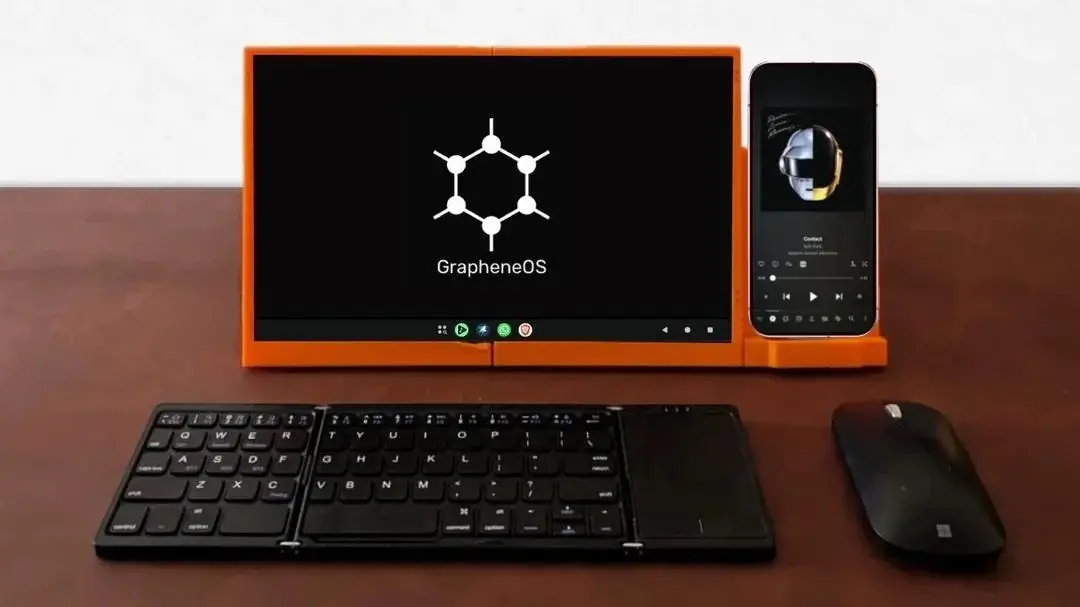
A GrapheneOS enthusiast has completed work on one of the most innovative DIY lapdocks seen in recent years. The project transforms a GrapheneOS-powered Pixel 9 into a portable desktop workstation using Android's Desktop Mode, while still allowing the phone's display to function independently as a secondary screen.
The Inspiration Behind the Build
According to the creator's Reddit post, the initial prototype was built approximately three months ago. The positive response from the GrapheneOS community motivated further refinement, leading to this final self-contained and easily portable version. The creator emphasizes that the design intentionally avoids copying traditional laptop form factors, instead adopting a unique folding mechanism inspired by sports car doors.
Key Features and Design Highlights
- Modular Construction: The lapdock uses a folding Bluetooth keyboard that snaps onto the front for transport. When needed, it detaches completely for ergonomic placement.
- Integrated Mouse Storage: A Bluetooth mouse slides into a compartment at the back, eliminating the need for separate carrying cases.
- Reinforced Stand and Carrying Options: The stand has been strengthened, and a carrying handle pairs with a shoulder strap, allowing the lapdock to function as a bag.
- Component Replaceability: All major components—display, power bank, keyboard, mouse, and phone dock—can be replaced individually, reducing electronic waste and improving upgradeability.
Technical Implementation
The majority of the chassis is 3D-printed, with internal space for a display controller board, a power bank, USB-C and HDMI connections, and the phone dock itself. The creator has published design files for free, enabling anyone with access to a 3D printer to build their own lapdock. For those without a printer, the files can be sent to manufacturing services for professional printing.
Why This Matters for Smartphone Computing
The project builds on the simple idea that today's flagship smartphones possess enough raw power to replace many entry-level laptops. The Pixel 9, when running GrapheneOS, offers enhanced privacy and security features while delivering punchy performance for tasks like browsing, document editing, and media consumption. The creator points out that using a phone as a primary computer means every smartphone upgrade also upgrades your laptop, eliminating the need to replace two devices separately.
Android's Desktop Mode has gradually improved over recent releases, offering a more polished multi-window experience similar to Samsung DeX but with the added advantage of GrapheneOS's privacy-focused approach. The lapdock takes this a step further by providing a dedicated hardware setup that rivals traditional laptops in convenience.
Expanded Context: The Shift Toward Modular Laptops
This DIY project aligns with a broader industry trend toward modular electronics—devices that allow individual component upgrades instead of entire device replacement. Companies like Framework and Fairphone have championed this philosophy in laptops and smartphones, respectively. By applying the same principle to a lapdock, the creator demonstrates that repairability and sustainability can coexist with high performance.
Moreover, the use of GrapheneOS, a security-hardened operating system based on Android Open Source Project, ensures that users benefit from regular security patches, verified boot, and sandboxed Google Play services. This makes the Pixel 9 + lapdock combination particularly appealing for users who prioritize digital privacy and control over their data.
Comparison with Existing Solutions
While commercial lapdocks exist for phones like the Samsung Galaxy series (e.g., NexDock), they are often expensive and not designed for the Pixel 9's form factor. Furthermore, most commercial solutions lack the modularity and open-source ethos of this DIY build. The creator's decision to release design files under a permissive license encourages experimentation and customization, potentially sparking a community of like-minded tinkerers.
The project also highlights the versatility of 3D printing in rapid prototyping. By iterating on the design based on community feedback, the creator achieved a polished final product within months. This agile development cycle is rarely possible with mass-manufactured consumer electronics.
Practical Implications for Everyday Use
For users who already own a Pixel 9 and GrapheneOS, building this lapdock offers a cost-effective way to get a laptop-like experience without purchasing a separate computer. The total cost of components—3D-printed parts, display, power bank, keyboard, mouse—can be significantly lower than a mid-range laptop. Additionally, since all components are standard off-the-shelf items, replacements and upgrades are straightforward.
The creator emphasizes that the lapdock is not intended to be a laptop replacement for heavy workloads like video editing or gaming, but rather a capable companion for productivity tasks, coding, office work, and media consumption. With the Pixel 9's performance and GrapheneOS's efficient resource management, the setup handles multitasking with ease.
One potential challenge is the reliance on Bluetooth for keyboard and mouse input, which may introduce slight latency compared to wired options. However, for most daily tasks, wireless peripherals offer sufficient responsiveness. The creator also notes that the display controller board's power draw is manageable, with a power bank providing several hours of additional runtime.
Future Plans and Community Involvement
The creator plans to release more DIY lapdock designs in the future, focusing on different screen sizes, keyboard layouts, and form factors. They invite feedback and contributions from the community, hoping to refine the concept further. The design files are hosted on GitHub under an open-source license, encouraging forks and derivative works.
This project serves as a prime example of how Android's Desktop Mode, combined with creative engineering, can unlock new possibilities for mobile computing. As smartphones continue to gain performance capabilities, lapdocks may become a viable alternative to traditional laptops for a growing segment of users.
For now, the GrapheneOS lapdock stands as a testament to what dedicated enthusiasts can achieve with 3D printing, open-source software, and a vision of repairable, modular computing.
Source: Android Authority News