

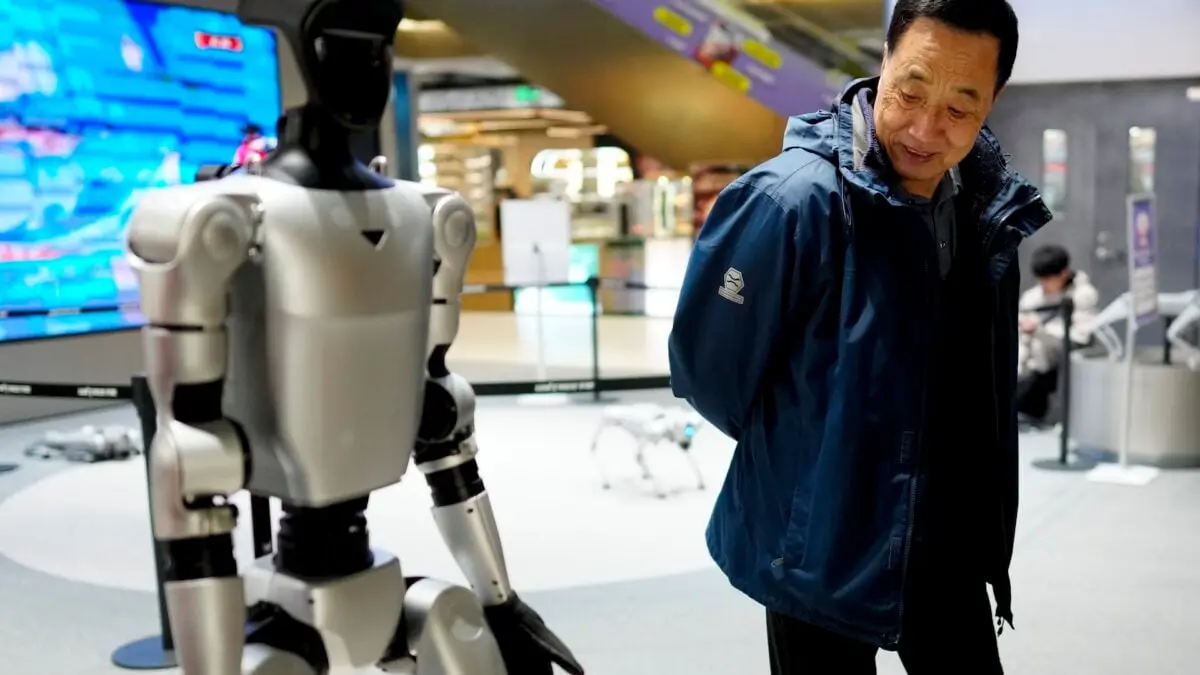
The U.S. Federal Communications Commission (FCC) announced a sweeping ban on advanced foreign-made robots Tuesday, in a move widely interpreted as an effort to curb China's rapidly expanding robotics and artificial intelligence industries. The ban specifically targets humanoid two-legged robots and four-legged quadrupeds, with the FCC stating that these machines “pose unacceptable risks to the national security of the United States or the safety and security of United States persons.”
The decision, issued on July 28, 2026, comes as part of a broader government study that identified potential supply chain vulnerabilities and cybersecurity risks associated with imported robots. According to the FCC release, national security agencies determined that these devices could be exploited for surveillance, sabotage, or data exfiltration, echoing concerns that previously led to the forced sale of TikTok to U.S. investors.
The ban covers not only humanoid and quadruped robots but also certain power inverters manufactured abroad. However, the Department of Defense (referred to as the Department of War in the FCC's press release) and the Department of Homeland Security have already granted exemptions for some inverter models. Companies may apply for conditional approval exemptions for specific products, indicating a targeted rather than blanket restriction.
President Donald Trump, who earlier this year reversed his stance on TikTok after wealthy U.S. and Middle Eastern interests expressed a desire to buy the platform, has been a vocal supporter of curbing Chinese technology imports. The FCC Chairman Brendan Carr, a Trump appointee, celebrated the ban in a statement, praising the president for his leadership in securing critical supply chains. Carr's remarks followed the administration's pattern of expressing deference to the president, as noted by the article's author.
The ban will not apply to robots that have already been purchased or imported before the announcement. This grandfather clause means that American consumers and businesses that already own foreign-made robots, such as those from China's Unitree, are unaffected. Unitree is likely the primary target of the new ban; the company sells the G1 humanoid robot and the Go2 and B2 robotic dogs, which have become popular in the U.S. thanks to viral social media videos showcasing their agility and capabilities.
Retailers may continue to sell previously approved models through the FCC's equipment authorization process. Additionally, the U.S. government is explicitly allowed to purchase any overseas robots it deems necessary for national security or other purposes, a provision that ensures federal agencies are not hindered by the ban.
The move is the latest salvo in an escalating technology war between the United States and China. Over the past decade, China has made enormous strides in robotics, AI, and advanced manufacturing. Companies like Unitree, Xiaomi, and DJI have become household names globally, challenging U.S. dominance in consumer electronics and industrial automation. The Biden administration had previously imposed export controls on advanced semiconductors and AI software, but the Trump administration has expanded these measures to include physical hardware like robots.
Industry analysts note that the ban could have significant repercussions for both countries. For the U.S., it may accelerate domestic robotics development by reducing competition from cheaper Chinese imports. Companies like Boston Dynamics, which produces the Spot quadruped robot, and Tesla, through its Optimus humanoid project led by Elon Musk, stand to benefit from reduced foreign competition. Musk, who has been a vocal critic of Chinese trade practices, implied on social media that the ban would help level the playing field for U.S. innovators.
However, critics argue that the ban could backfire. By limiting access to advanced robotics from China, U.S. businesses and research institutions may lose out on valuable tools for automation, medical surgery, disaster response, and education. Unitree's robots, for example, are significantly cheaper than comparable American models, making them accessible to smaller companies and universities. The ban could also provoke retaliatory measures from Beijing, potentially disrupting supply chains for critical components such as batteries, rare earth elements, and sensors.
The broader context includes a shifting geopolitical landscape where technology has become a central front in U.S.-China rivalry. The FCC's action mirrors earlier restrictions on Huawei and ZTE telecom equipment, as well as the forced divestiture of TikTok. In each case, the U.S. government has cited national security concerns, while critics accuse it of using security as a pretext for protectionism.
The ban does not cover military robots or dual-use technologies that are already regulated under arms control regimes. Notably, the U.S. Department of Defense has continued to develop and deploy its own robotic systems, including the Air Force's Skyborg and the Army's Robotic Combat Vehicle programs. The exemption for government purchases ensures that these programs remain unaffected.
For the average American consumer, the immediate impact may be limited. Those who already own Unitree or other Chinese robots can continue using them, and retailers can sell existing stock. But future purchases of foreign-made humanoid robots will require FCC approval, which is unlikely to be granted given the current political climate. This could slow the adoption of personal robotics in the U.S., where companies like Amazon have already deployed home robots like Astro, and where robotic lawnmowers and vacuum cleaners have become common.
The ban also raises questions about the definition of “foreign-made” in an increasingly globalized supply chain. Many robots incorporate components from multiple countries, including U.S. chips, Japanese motors, and European software. The FCC's classification may hinge on where the final assembly takes place or where the intellectual property originates, potentially creating loopholes for companies to circumvent the ban by shifting production teams or licensing agreements.
In response to the announcement, Unitree declined to comment officially but posted a cryptic message on Chinese social media platform Weibo, stating that “innovation cannot be contained by walls.” Meanwhile, the Chinese government has not yet issued a formal response, though state-affiliated media outlets have condemned the ban as “technological isolationism” and “a desperate attempt to maintain hegemony.”
The FCC's decision marks a significant escalation in the U.S. government's intervention in the robotics market. Previous administrations had focused on software and telecommunications, but the inclusion of physical robotic platforms signals that Washington now views the entire robotics ecosystem as a critical national security concern. This broadening of scope is likely to continue, as the lines between hardware, software, and data become ever more blurred.
As the ban takes effect, the robotics industry braces for a period of uncertainty. Startups that relied on Chinese components or designs may need to pivot, while established American firms scramble to fill the gap. The long-term impact on innovation and international cooperation remains to be seen, but one thing is clear: the race to build the next generation of robots will be fought not only in laboratories and factories but also in the halls of government and the pages of trade regulations.
Source: Gizmodo News