
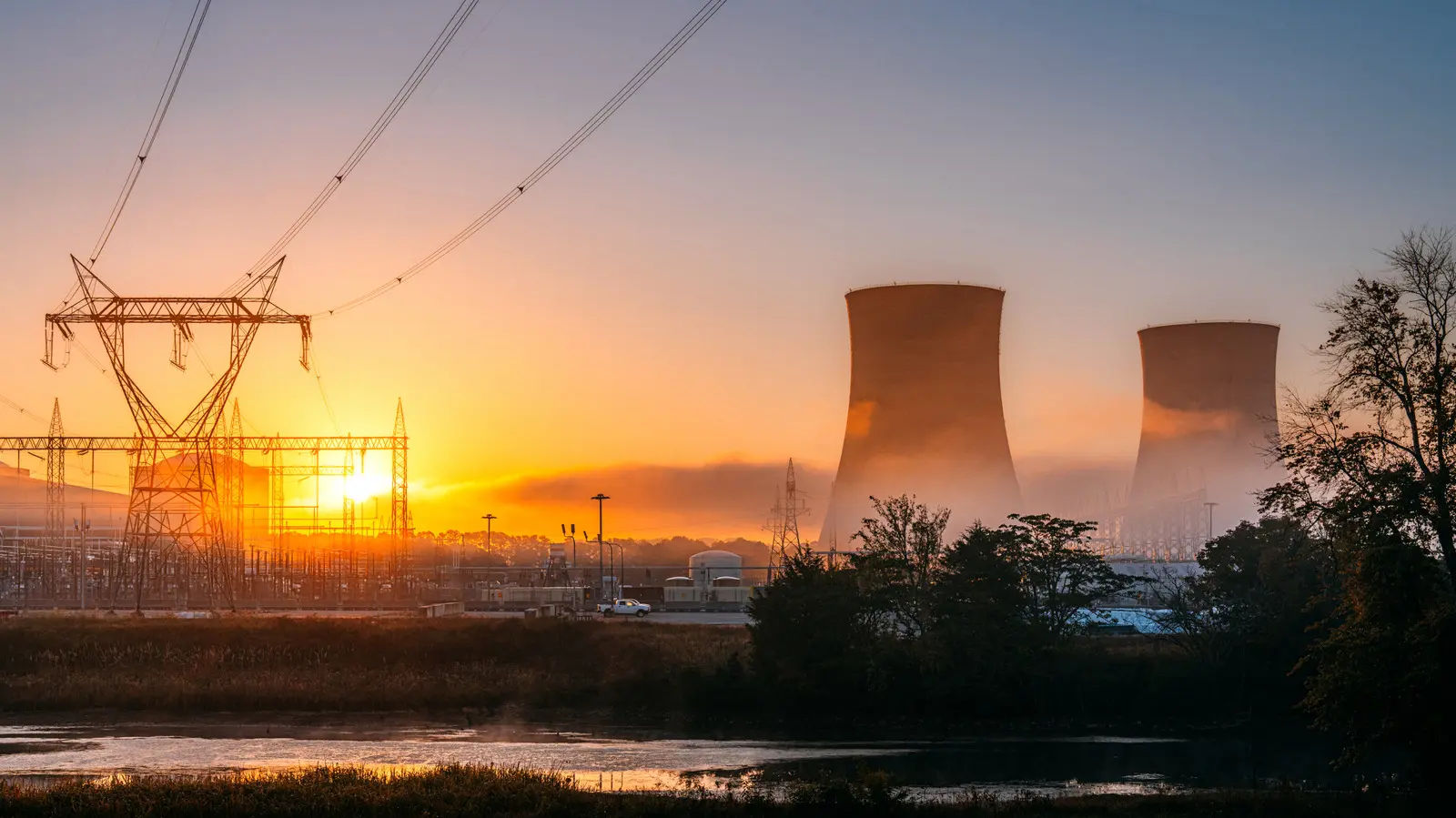
The United States operates more nuclear power plants than any other nation, yet the technology remains a polarizing topic. To understand the debate, it helps to grasp the fundamental science behind nuclear reactors: how they work, what they produce, and why they generate such massive amounts of power from minimal fuel.
The Physics of Nuclear Energy: E=mc²
The foundation of nuclear energy is Albert Einstein's famous equation, E=mc². This shows that mass (m) can be converted into energy (E), and because the speed of light (c) is enormous, even a tiny fraction of mass releases an immense amount of energy. In a reactor, this conversion happens through nuclear fission, where the nucleus of a heavy atom—typically uranium-235—is split into two lighter nuclei. The process releases both energy and neutrons, which then split other uranium atoms in a self-sustaining chain reaction.
Each fission event yields about 200 million electron volts (MeV) of energy, compared to just a few eV from chemical reactions like burning coal. This density is why a single uranium pellet the size of a fingertip can produce as much energy as a ton of coal.
Core Components and How They Control the Reaction
A nuclear reactor's core contains fuel rods packed with uranium dioxide pellets. Control rods, made from neutron-absorbing materials like boron or silver, slide into the core to regulate the reaction. By raising or lowering them, operators can speed up, slow down, or halt fission. Water serves a dual role: it moderates neutrons (slowing them to increase the chance of fission) and cools the core by carrying away heat. Without control, the reaction could overheat and cause a meltdown, so safety systems and multiple backup mechanisms are standard.
Spent fuel remains highly radioactive, requiring storage in cooling pools or dry casks. This waste management issue is one of the technology's biggest challenges.
Two Dominant Commercial Reactor Designs
Most American power reactors are either Pressurized Water Reactors (PWRs) or Boiling Water Reactors (BWRs). PWRs keep primary-loop water under high pressure to prevent boiling. That water circulates through a heat exchanger, where heat transfers to a secondary loop. Steam from the secondary loop drives turbines. BWRs, by contrast, allow water to boil directly in the core, and the steam is piped straight to the turbines. Both designs achieve comparable efficiency, but PWRs offer an extra layer of isolation between radioactive water and the environment. About 65% of U.S. commercial reactors are PWRs.
Beyond electricity generation, reactors produce heat for district heating, desalination, and hydrogen production. Small modular reactors (SMRs) and advanced designs now under development promise even wider applications.
Naval and Military Reactors
The U.S. Navy uses scaled-down PWRs in aircraft carriers and submarines. Unlike civilian reactors that employ low-enriched uranium (LEU, typically 3-5% U-235), naval reactors use highly enriched uranium (HEU, over 90% U-235). This allows ships to operate for decades without refueling—a critical advantage for extended deployments. The USS Gerald R. Ford, the world's largest carrier, is powered by two A1B reactors that deliver 25-year core life. Refueling such vessels is a major undertaking that occurs only once in a ship's lifetime.
Military reactors also prioritize compactness, durability, and resilience to shock, differing from the cost and efficiency focus of commercial plants.
Historical Context and Innovations
The first artificial nuclear reactor, Chicago Pile-1, was built in 1942 as part of the Manhattan Project. It used uranium, graphite moderators, and cadmium control rods. Commercial power reactors emerged in the 1950s, with the Shippingport Atomic Power Station in Pennsylvania being the first full-scale plant in the U.S. Since then, reactor designs have evolved to improve safety, reduce waste, and increase efficiency. Fourth-generation reactors, including molten-salt and fast-neutron designs, aim to burn existing nuclear waste and operate with greater thermal efficiency.
However, public fear after accidents like Three Mile Island (1979), Chernobyl (1986), and Fukushima (2011) slowed new construction in many countries. In the U.S., regulatory hurdles and high upfront costs have also limited expansion.
Despite debates, nuclear power provides about 20% of U.S. electricity and 50% of its carbon-free electricity. As climate goals push for decarbonization, interest in nuclear energy is reviving, with research into fusion reactors and advanced fission technologies gaining momentum.
Source: SlashGear News